 AI Essay

On this page
Choose the model before interpreting kappa
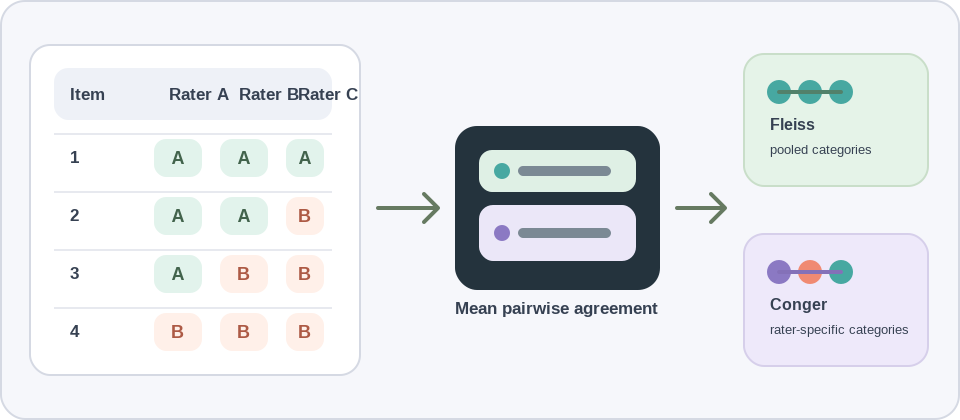
Fleiss and Conger use the same mean pairwise observed agreement but define expected agreement differently. Fleiss (1971) pools category proportions across all ratings, treating raters as interchangeable. This model is commonly used when each item receives the same number of ratings from raters treated as draws from a larger pool.
Conger (1980) uses each rater’s own category proportions and averages the expected agreement over rater pairs. Choose this model when the same fixed panel rates every item and those particular raters are the panel of interest. If your fixed team is meant to represent a wider population, the intended estimand and sampling plan should guide the choice; the matrix alone cannot decide it.
The option called Conger is sometimes labeled “exact” in statistical software. Here it means Conger’s alternative kappa formulation, not an exact significance test. Fleiss’ kappa does not become unweighted Cohen’s kappa when there are two raters. For exactly two raters, use the separate Cohen calculator and report that method explicitly.
How the multi-rater calculation works
For item i, let nᵢⱼ be the number of its raters who chose category j, and let m be the number of raters. Its pairwise agreement is Pᵢ = Σⱼ nᵢⱼ(nᵢⱼ − 1) ÷ [m(m − 1)]. The calculator averages Pᵢ across items to obtain observed agreement P̄.
Fleiss expected agreement is Pₑ = Σⱼ pⱼ², where pⱼ is the proportion of all ratings in category j. Conger expected agreement is the average, across each distinct rater pair, of the sum of their rater-specific category proportions multiplied category by category. For either model, κ = (P̄ − Pₑ) ÷ (1 − Pₑ).
Worked example: for four items rated A/A/A, A/A/B, A/B/B and B/B/B, pairwise item agreement is 1, ⅓, ⅓ and 1. Mean pairwise agreement is ⅔; two of four items are unanimous. Fleiss expected agreement is ½, giving κ = ⅓. Conger expected agreement is 11/24, giving κ = 5/13 (about 0.385). The observed ratings did not change; the chance model did.
Prepare the rating matrix
Paste a tab-separated matrix with one item per row and one rater per column. Every row must contain the same number of category labels, and every item must have a rating from every rater. Keep labels consistent; “include” and “Include” are treated as different categories. This tool does not impute or silently omit missing values.
The calculation runs in this browser and the labels are not sent to AI Essay. Use non-identifying example data on shared devices. Preserve the original ratings before a discussion or adjudication changes any decisions.
Interpret and report the result with its limits
Report which model you selected, why it fits the rater design, the number of items and raters, category definitions, mean pairwise observed agreement, expected agreement and kappa. Inspect the category counts and the proportion of unanimous items as separate summaries. A single kappa value can hide category prevalence and the pattern of disagreement.
There is no universal kappa cutoff that establishes acceptable agreement across disciplines. Kappa does not show that labels are valid, raters are unbiased, a codebook is adequate, or items represent the target population. This calculator reports a descriptive coefficient only; it does not calculate a p-value, confidence interval, sample size or adjudicated answer.
Free multi-rater agreement calculator
Compare agreement across raters
Paste one item per row and one rater per tab-separated column. Then choose the chance model that matches your design.
A	A	A
A	A	B
A	B	B
B	B	B
Your ratings stay in this browser. Do not enter identifiable or confidential records on a shared device.
Choose a rater model to calculate the constructed example.
Agreement summary
Selected kappa
Mean pairwise agreement
Expected agreement
Items · raters
The selected model changes expected agreement, not the observed ratings. Interpret this coefficient with its rater design, category counts and field-specific standards. No universal cutoff is applied.
Questions about this topic
What is the difference between Fleiss and Conger kappa?
They calculate the same mean pairwise observed agreement but use different expected-agreement terms. Fleiss pools category frequencies across ratings and treats raters as interchangeable. Conger averages chance agreement based on each rater’s own category frequencies.
Should I use Fleiss or Conger for the same three reviewers?
If those particular reviewers are the fixed panel of interest and each rated every item, Conger’s rater-specific formulation is a useful match. If raters are treated as interchangeable draws from a broader pool, Fleiss uses the pooled category proportions. State the sampling and inference target; the calculator cannot infer it from the matrix.
Can I use this calculator with two raters?
The formulas accept two or more raters, but Fleiss’ formulation does not reduce to Cohen’s unweighted kappa at two raters. For exactly two raters, use the separate Cohen calculator and specify Cohen’s method.
What if one rater did not score an item?
This calculator requires complete rows with the same number of ratings. It rejects missing cells rather than silently dropping items; choose and document a missing-data method suited to your design before calculating.
Why is kappa undefined when every rating is in one category?
When expected agreement is 1, the denominator 1 − Pₑ is zero. The calculator still reports the observed agreement and unanimous-item count, but leaves kappa undefined.
Does a kappa value show that the coding is reliable?
Kappa summarizes agreement relative to a chosen expected-agreement model. It does not validate the categories, sampling, rater training, blinding or construct measurement, and there is no universal cutoff for every field.
Are my ratings uploaded?
No. The calculation runs in this browser tab; labels are not sent to AI Essay.
Sources and editorial notes
The supporting reading below informs our editorial guidance. Exercises and scenarios illustrate a method; they do not report a completed product test or measured learning outcome. Read our editorial policy or send a correction with a supporting source to info@ai-essay.com.
- CRAN irr reference manual: Fleiss and Conger multi-rater kappa formulations
- Fleiss: Measuring nominal scale agreement among many raters
- Conger: Integration and generalisation of Kappas for multiple raters
- Psychometrika review: agreement coefficients and rater interchangeability
- PubMed: Kappa statistics for multiple raters