 AI Essay

On this page
Start with the actual abstract instructions
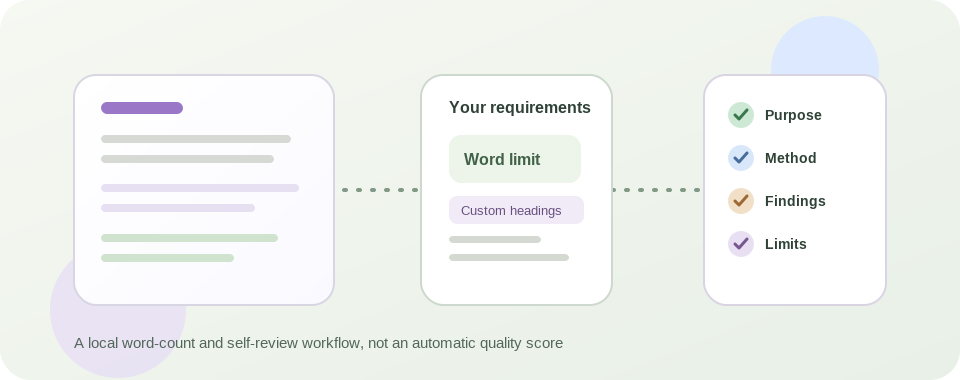
Abstract limits and section labels depend on the assignment or publication. The National Library of Medicine explains that structured abstract headings and formats vary among journals; APA also tells student writers to check with their instructor or institution and notes that its 250-word guidance may differ from course or journal requirements. Enter the limit and headings from the source that applies to your submission. Leave the limit blank if no limit is given.
This checker does not include journal presets or decide whether a rule applies to your paper. Check the journal’s current instructions, call for papers, dissertation handbook or assignment sheet. Confirm whether headings, keywords, title text, citations, symbols or hyphenated terms count, because submission systems and word processors can differ.
Use the word counter and section view
Paste a draft, choose unstructured or structured, and enter an optional whole-number limit. In structured mode, list the required headings one per line and write each heading on its own line in the draft, with an optional colon. The tool shows a whitespace-based total and counts text beneath each detected heading. Heading labels are included in the overall count, while per-section counts cover the section text; check the venue’s counting rule before submission.
The count is a practical local estimate, not a promise that a journal submission system will tokenize the draft the same way. Different word processors may treat hyphens, em dashes, symbols, abbreviations and headings differently. Compare the final text with the submission portal’s count when available.
Review each claim against the completed report
Use the checklist to remind yourself to verify the purpose, approach, central finding or argument, important qualification and final format. These are prompts for your own review; ticking a box does not verify content. The checker does not read, upload, store, score, rewrite or fact-check the abstract, and it cannot tell whether a method or result is represented accurately.
Compare every number and substantive claim with the finished report, including its units, denominators, population and time point where relevant. Do not describe planned work as completed, infer causation from a design that does not support it, or remove a qualification that changes how a finding should be understood. Follow your institution’s rules on writing assistance and disclosure.
Know what the checker does and does not do
The checker counts words, compares that count with a limit you provide and identifies user-defined heading lines. It does not determine the right abstract format, infer missing sections, judge quality, assess evidence, detect plagiarism, predict acceptance or guarantee compliance. Its prompts are a review aid, not a journal’s editorial criteria.
The draft is processed in this browser tab. The tool does not upload or automatically save the text. Avoid entering confidential material on a shared device; your browser or device may have its own history, clipboard or security settings.
Free browser-based writing tool
Check your abstract draft
Set the rules from your assignment or target journal. Your draft stays in this browser tab.
Counting runs locally in this tab. Your text is not uploaded or automatically saved.
Enter your own limit and required headings; this tool does not assume a universal format.
Draft check
0 words
Words by section
Questions about this topic
What is a good word limit for a research abstract?
Use the limit specified by your journal, conference, department or assignment. Requirements vary, so this checker leaves the limit to you instead of assuming that one number applies to every abstract.
Which headings should I use for a structured abstract?
Use the labels and order required by the venue. Structured abstract formats vary among journals; this checker accepts custom labels and does not prescribe a universal set.
How does this tool count words?
It counts whitespace-separated text tokens containing a letter or number. Heading labels are included in the total; per-section counts cover the text beneath each recognized heading. Hyphenation, punctuation and submission-system rules may produce a different count.
Does it check whether my abstract accurately summarizes my paper?
No. It does not compare the abstract with your report or judge whether claims are supported. Use the checklist, then verify each method, result, number and qualification against the completed work.
Is my abstract uploaded or saved?
No. Counting and section detection run in this browser tab. The tool does not upload or automatically save the text.
Sources and editorial notes
The supporting reading below informs our editorial guidance. Exercises and scenarios illustrate a method; they do not report a completed product test or measured learning outcome. Read our editorial policy or send a correction with a supporting source to info@ai-essay.com.