 AI Essay

On this page
Free, local APA 7 tool
Compare citations with your reference list
Paste your paper text and references. The checker looks for common author–year patterns and points out items to inspect.
Paste plain text. Parenthetical author–year citations and common narrative author (year) forms are checked.
Indented continuation lines are joined to the previous entry. Include each reference’s author and year.
Your text stays in this browser tab. It is not uploaded or saved. This checks a limited author–year subset; it does not verify sources or APA formatting.
Match report
Compare in-text author–year citations with reference entries
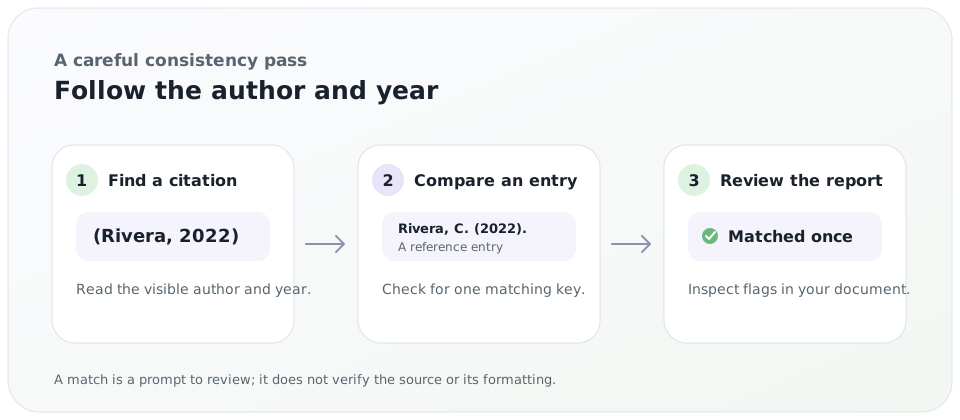
APA Style calls for correspondence between an in-text citation and a reference-list entry. This checker looks for common author–year patterns, compares the first author or group name and year, and reports likely unmatched citations, reference entries that were not cited, repeated author–year entries and citations that point to more than one entry. Those are review prompts, not automatic corrections.
APA’s in-text checklist also asks writers to compare author spelling, author abbreviation and publication year, and to make sure each citation matches only one entry. This tool checks only the visible author–year key in its supported patterns. It cannot confirm that the source exists or that the entry is complete, accurate or relevant to the cited sentence.
Use the checker with a supported APA 7 subset
Paste the paper text and reference entries as editable plain text. The first version recognizes common parenthetical citations such as (Rivera, 2022), (Rivera & Chen, 2022), (Rivera et al., 2022), several works separated by semicolons, and many narrative forms such as Rivera (2022). It reads reference entries with a visible year in parentheses and compares their first author or group name and year, including a year suffix such as 2022a.
For references, use one entry per paragraph or line. Wrapped lines that begin with spaces are joined to the preceding entry. Keep punctuation and author order intact so you can compare the flagged text with your own paper. If the tool cannot identify an entry’s author and year, it lists that line for manual review instead of silently treating it as a match.
Review ambiguous cases instead of trusting a clean count
Author–year matching is not full APA validation. The tool does not check capitalization, punctuation, italics, DOI or URL accuracy, source existence, whether a quotation has a page number, or whether the cited source supports the claim. Different works by the same author in the same year, shortened group-author names, complex author lists and unusual reference forms can need a human decision even when a match appears.
Personal communications are generally cited in text rather than included in the reference list. Do not treat every citation with no reference entry as an error: check whether it is an exception, whether your course uses a different rule, or whether the author/year text fell outside this tool’s supported subset. Follow your instructor’s requirements when they differ from general APA guidance.
Keep the paper and reference list in your browser
The comparison runs in this browser tab. The tool does not upload or save the text you paste. Clear both fields when you finish, especially on a shared device, and do not paste material you are not allowed to handle in that environment.
Use the findings as a final consistency pass: fix one issue at a time in your source document, then run the check again. Open the matching source record and inspect the original paper or publisher/library details before correcting a reference. This page reports no account trial, source lookup or automated verification.
Supporting reading: [1]
Questions about this topic
What does the APA 7 citation checker compare?
It compares common visible author–year citations in your paper with the first author or group name and year parsed from reference entries. It can flag likely missing matches, unused references, duplicate entries, ambiguous matches and reference lines it cannot parse.
Does this tool verify that my sources or DOIs are real?
No. It does not search the web, a library database or a DOI registry. Open each source record and verify its details and relevance yourself.
Does it check every APA 7 citation format?
No. The first version focuses on common author–year citations and reference entries with a visible year in parentheses. Unusual forms, shortened group names, personal communications and complex same-author cases need manual review.
Are my paper and references uploaded?
No. The comparison runs in your browser tab and does not upload or save the pasted text. Clear the fields when finished on a shared device.
If the checker reports no gaps, is my reference list correct?
No. A clean match report does not validate APA formatting, source existence, source accuracy, quotation locators, or whether a source supports a claim. Inspect each item against APA guidance and the original source.
Sources and editorial notes
The supporting reading below informs our editorial guidance. Exercises and scenarios illustrate a method; they do not report a completed product test or measured learning outcome. Read our editorial policy or send a correction with a supporting source to info@ai-essay.com.