 AI Essay

On this page
Free, local MLA 9 tool
Compare citations with Works Cited
Paste your draft and Works Cited entries. The checker looks for common author-and-page patterns and points out items to inspect.
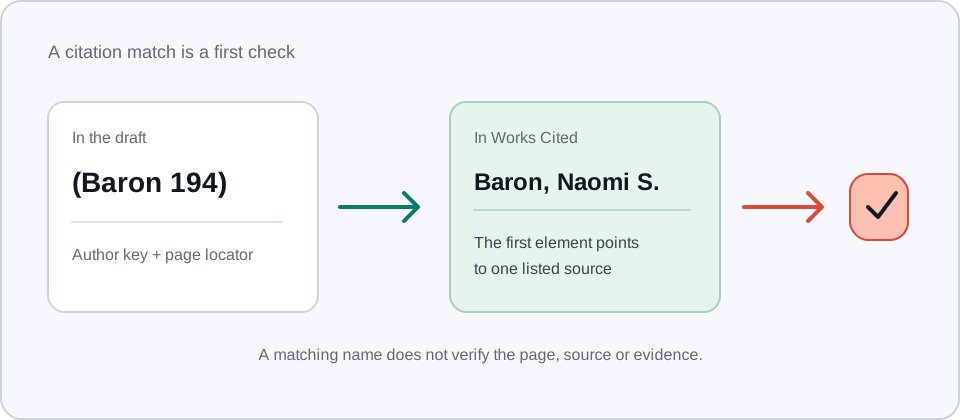
Supported examples include (Baron 194), (Smith and Jones 27), and (Rivera et al. 14–16).
Indented continuation lines are joined to the preceding entry. This version does not match title-keyed or no-author entries.
Your text stays in this browser tab. It is not uploaded or saved. This checks a limited author-and-page subset; it does not validate MLA formatting, sources or evidence.
Match report
Check whether common author-and-page citations point to a Works Cited entry
MLA Style Center explains that an in-text citation begins with the shortest element that directs a reader to the corresponding Works Cited entry, usually an author or title. When a source has a useful location marker, the citation can include it. This checker focuses on a narrower, mechanical question: do parenthetical citations with an author name and page-like locator appear to connect to exactly one author-first entry?
The browser tool reports likely matches, unmatched author keys, ambiguous cases, author-first entries not seen in the supported citations, and entries it cannot parse. These are review prompts. A citation can point to the right author while still using the wrong page, representing the source inaccurately, or failing to support the sentence.
Use the supported MLA subset and inspect anything outside it
The checker recognizes parenthetical patterns such as (Baron 194), (Smith and Jones 27), and (Rivera et al. 14–16), then compares the first named contributor with the beginning of each Works Cited entry. Paste one Works Cited entry per line or paragraph; indented continuation lines are joined to the preceding entry. It currently parses common author-first entries and page-number locators.
It does not reliably match a citation keyed to a shortened title, an entry with no listed author, a locator-only citation after the author is named in prose, an unpaginated work, a line or timestamp, or complex multiple-author collisions. Some abbreviated group-author names may also need manual review. A reference cited without a page-like locator may appear as unused because this tool cannot connect that citation. It marks repeated author keys as ambiguous rather than guessing which source you meant. Check such cases manually against the MLA Handbook, instructor directions and your source.
Keep formatting, source identity and evidence review separate
A matching author does not verify the Works Cited entry’s punctuation, title, container, publication details, URL, access date or hanging indent. It does not establish that a source exists, that the locator is correct, or that the passage supports your claim. Open the original source and compare the cited material with the sentence in your paper.
Use the MLA Works Cited formatter for a supported page-layout task, and the in-text citation builder for common author-page examples. Follow the exact assignment and edition requirements if they differ. Clear the fields when you finish, especially on a shared device.
Keep the draft in this browser tab
The checker runs on the text in your current browser tab; it does not upload or save it. Avoid pasting information you are not permitted to handle on that device. Clearing the form removes the text from its visible fields.
Questions about this topic
What does the MLA citation checker compare?
It compares common parenthetical author-and-page citations with author-first Works Cited entries pasted into the second field. It flags likely unmatched, ambiguous, unused or unparsed items.
Does it check shortened-title citations?
No. This version focuses on author-first Works Cited entries. Citations keyed to titles, entries without an author, and locator-only citations need manual review.
Does a match mean my MLA citation is correct?
No. A match only indicates that the parsed author key appears in one Works Cited entry. Check the locator, formatting, source identity and evidence yourself.
Is my paper uploaded?
No. The comparison runs in the current browser tab and does not upload or save the pasted text.
Sources and editorial notes
The supporting reading below informs our editorial guidance. Exercises and scenarios illustrate a method; they do not report a completed product test or measured learning outcome. Read our editorial policy or send a correction with a supporting source to info@ai-essay.com.