 AI Essay
On this page
When weighted Cohen’s kappa fits
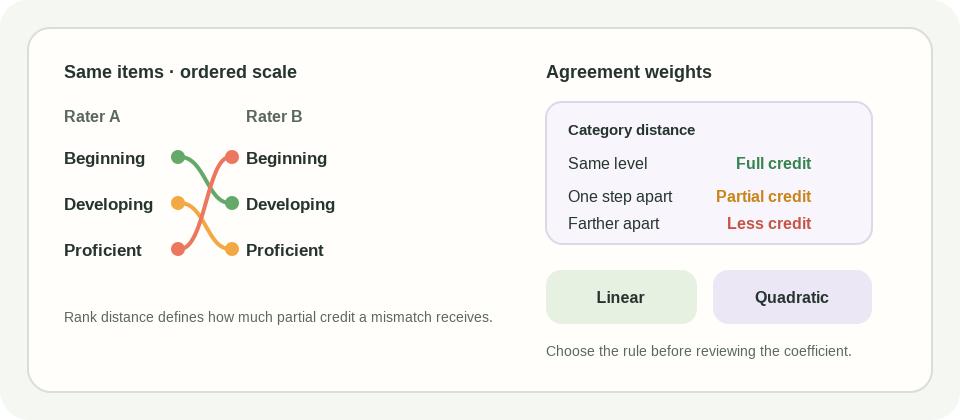
Weighted Cohen's kappa is a descriptive agreement coefficient for two raters who independently assign one rating to each of the same items on a shared ordered category scale. It is suited to ordinal rubrics or rating levels when the analysis plan treats some disagreements as closer than others. This calculator requires complete, aligned ratings from exactly two raters.
The order matters. Enter every level from lowest to highest, including a level that happens not to appear in this sample. The calculator does not infer an order alphabetically or from numeric label text. Choose the categories and weighting rule before looking at the result, and explain that choice in your report.
Choose linear or quadratic weights before analysis
Both available schemes give full agreement credit to ratings in the same category and reduce credit as the category ranks move apart. Linear weights reduce credit in proportion to rank distance. Quadratic weights reduce credit in proportion to squared rank distance, so distant mismatches count more heavily relative to adjacent mismatches. These weights use rank steps: every neighboring pair is treated as one step apart, even if the labels have numeric values.
There is no universally correct choice between linear and quadratic weighting. Use the scheme justified by the scale, research question and analysis plan; do not choose whichever produces the larger coefficient. The displayed weighted kappa can change when the category order or weight scheme changes.
How weighted agreement is calculated
The calculator forms a cross-tabulation where each cell counts items assigned category i by Rater A and category j by Rater B. Agreement weights are 1 on the diagonal and decrease with rank distance: 1 − |i − j|/(K − 1) for linear weights, or 1 − ((i − j)/(K − 1))² for quadratic weights, where K is the number of ordered categories.
Observed weighted agreement is the sum of each cell proportion multiplied by its agreement weight. Expected weighted agreement uses the product of the two raters’ observed category proportions for each cell. The coefficient is κw = (observed weighted agreement − expected weighted agreement) ÷ (1 − expected weighted agreement). Exact agreement is also shown so the fractional credit from the weight scheme is visible.
A coefficient is undefined when expected weighted disagreement is zero, for example when both raters use only the same single category. The tool reports “Undefined” rather than substituting a value.
Report the table, scale and weighting rule
A clear report identifies the two-rater design, number of paired items, ordered category labels, linear or quadratic weighting, weighted Cohen’s kappa, the cross-tabulation and exact agreement. Explain how the scale was defined, how raters were trained, and how disagreements were handled. Kappa alone does not show whether the rubric measures the intended construct, whether the sample represents the target population, or whether categories are valid.
This page does not provide confidence intervals, significance tests, custom weights, missing-data adjustments or methods for more than two raters. Use unweighted Cohen’s kappa for nominal labels when disagreement distances have no justified order. For three or more raters, choose a multi-rater method suited to the study design.
Ordinal agreement calculator
Calculate weighted agreement
Order the rating scale from lowest to highest. Then enter one rating per item for each rater; matching line numbers must refer to the same item.
Beginning
Developing
Proficient
Your category labels and ratings stay in this browser. Do not enter identifiable or confidential records on a shared device.
Edit the 6-item example or enter your aligned ordinal ratings, then calculate.
Agreement summary
Weighted Cohen’s κ
Observed weighted agreement
Expected weighted agreement
Exact agreement
Paired items
Weighting
Interpret the coefficient with the ordered scale, selected weights and full table. No universal cutoff is applied.
Questions about this topic
What is the difference between weighted and unweighted Cohen’s kappa?
Unweighted Cohen’s kappa treats every disagreement as the same kind of mismatch. Weighted kappa uses the declared order of categories to give partial agreement credit to near disagreements and less credit to more distant disagreements. Use weights only when the order and distance rule are substantively justified.
Should I choose linear or quadratic weights?
Choose the scheme that fits the scale and analysis plan before reviewing the result. Linear weights reduce credit in proportion to rank distance; quadratic weights penalize larger rank gaps more strongly relative to adjacent gaps. Neither is universally correct.
Does this calculator know the category order?
No. Enter all categories from lowest to highest, one per line. The order you supply determines the rank distances; labels are not sorted automatically.
Can I use weighted Cohen’s kappa for three or more raters?
No. This calculator is for exactly two raters. Use a multi-rater agreement method designed for your number of raters and study design.
Does a high weighted kappa prove that a rubric is valid?
No. The coefficient summarizes agreement under the selected weights and expected-agreement model. It does not validate the rubric, category definitions, training, sample or measured construct. Report the table and study context, and follow standards for your field.
Are the ratings sent to AI Essay?
No. The calculation runs in this browser tab. The category labels and ratings are not sent to AI Essay.
Sources and editorial notes
The supporting reading below informs our editorial guidance. Exercises and scenarios illustrate a method; they do not report a completed product test or measured learning outcome. Read our editorial policy or send a correction with a supporting source to info@ai-essay.com.
- IBM SPSS Statistics: weighted Cohen’s kappa for two ordinal raters and shared categories
- scikit-learn API: Cohen’s kappa label ordering and linear or quadratic weighting
- scikit-learn source: observed and expected weighted disagreement calculation
- Cohen: Weighted kappa with scaled disagreement or partial credit