
Download the templates
Original printable PDFs, CSV working tables and an editable plain-text worksheet. The filled example is constructed practice material, not a real lecture or study.
- Blank Cornell notes worksheet for printingPDF · 23 KB
- Cornell notes worked example and practice sourcePDF · 26 KB
- Blank cue-and-note working tableCSV · 239 bytes
- Constructed lecture: filled note tableCSV · 2 KB
- Editable worksheet and worked exampleTXT · 4 KB
Open a blank file for your own work. Keep examples separate from your evidence and follow the instructions below.
On this page
Give cues, notes and summary different jobs
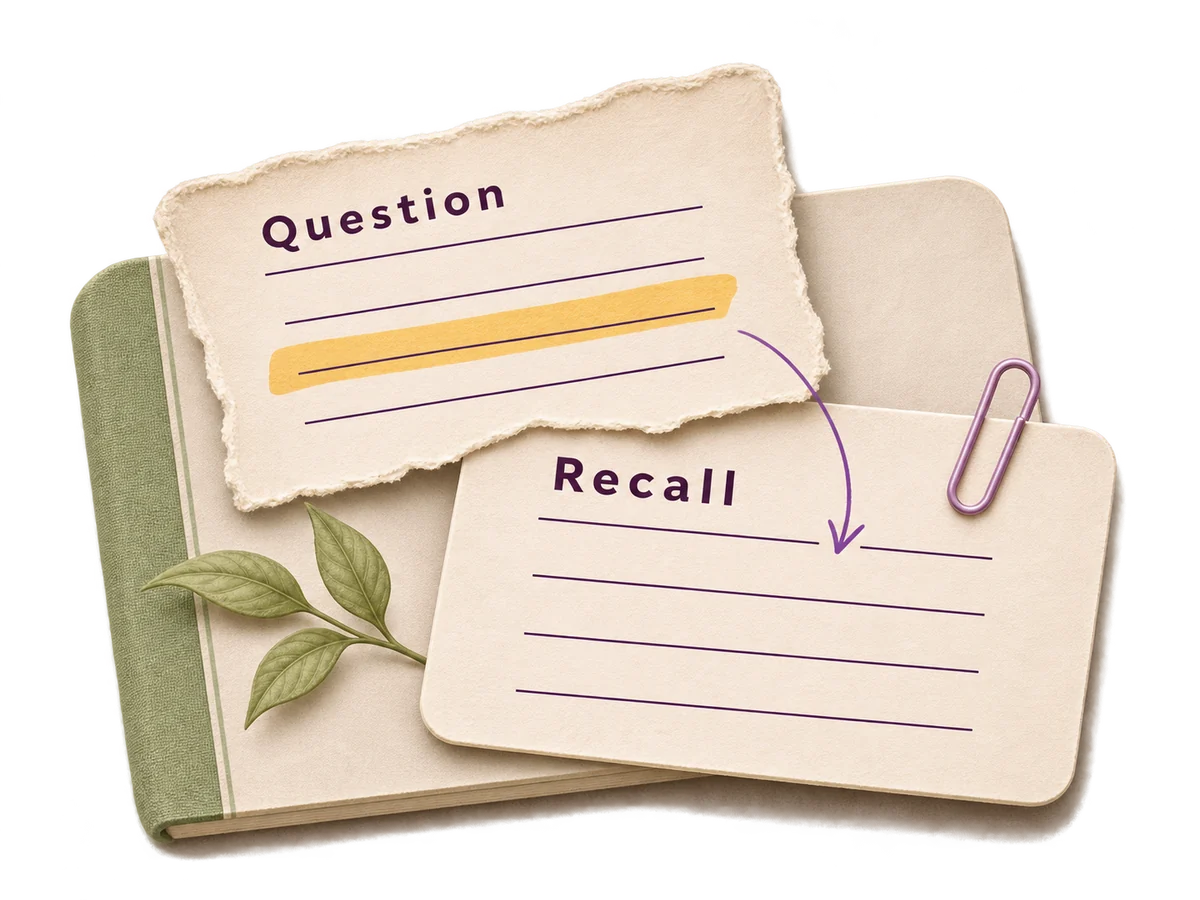
A Cornell-style page separates a narrow cue area, a larger notes area and a summary area below. The layout helps keep prompts apart from the explanations you will check. Stanford describes a reading version with notes on the right, key concepts on the left and a brief statement connecting them at the bottom. Our worksheet adapts that general method with questions, source locators and an uncertainty field; it is an original resource, not a university handout.
Use the cue area for a concept or a question you can answer. Use the notes area for the relevant explanation, example or relationship. The summary should connect the main ideas instead of adding an unsupported conclusion. Record the source or session at the top and keep useful page, section or timestamp references with the notes.
The three areas need not have rigid dimensions. A diagram may need more room than a definition, and a discussion may need space for competing interpretations. Cornell encourages readers to assess which note-taking strategy fits their situation. This template is a starting structure, not a rule that every lecture or learner must use.
Capture the explanation, then repair the record
During a permitted lecture or reading, record the important point and its qualification rather than trying to fill every line. Mark a missed word or unresolved step so you can return to it. Keep an exact quotation visibly separate from your paraphrase, and distinguish the speaker’s claim from a question or inference you add.
Afterward, compare a difficult term or surprising conclusion with the approved source. A transcript can help locate a spoken passage, but it is a separate record that may contain errors. Correcting a transcript is not the same task as deciding what belongs in your notes. Keep the locator so the explanation remains recoverable when you revise the summary.
For an audio-based workflow, obtain the necessary permission before recording or uploading course discussion. Review the accessible length, exports and sharing controls of any service you use. The Otter.ai and Notta profiles address those product-specific choices; this page teaches a method you can use with or without either service.
Worked example: association without a causal conclusion
Original constructed practice lecture. No real club, participants, measurements, study or product test is reported.
Practice lecture, entirely constructed: (1) Imagine a campus club notices that members who attend more discussion sessions also report reading more pages. (2) This describes an association in the imagined record; it does not show that attendance caused the extra reading. (3) Prior interest could influence both attending and reading, and keen readers might choose to attend more often. (4) No random assignment, time-ordered comparison or measurement procedure is supplied in this example. (5) A causal explanation would need evidence that addresses plausible alternatives, with a design appropriate to the question. (6) Do not infer that the sessions are useless: this record leaves their causal effect unresolved.
Question for the notes — What can an observed association establish, and what remains unresolved?
The rows below preserve qualifications and identify the sentence behind each note. The source is the numbered practice passage above. It is not a publication to cite as research evidence, and the filled sheet is not a tested student result.
Scroll the table sideways to view all columns.
| Cue or question | Own-word note | Locator and check |
|---|---|---|
| What is the association? | More session attendance and more reported reading occur together in the imagined record. This does not establish the direction or cause of the relationship. | Practice lecture, sentences 1–2. Keep 'reported' and 'imagined'; do not turn the scenario into measured research. |
| What alternative explanations are possible? | Prior interest might affect both activities. People who already read more might choose to attend more sessions. | Practice lecture, sentence 3. These are possible explanations, not causes established by the example. |
| What would a causal claim need to address? | The example supplies no procedure or comparison capable of resolving the alternatives. A suitable design would need to address them. | Practice lecture, sentences 4–5. Do not prescribe one design as sufficient for every question; no real investigation is described here. |
| Does lack of a causal conclusion mean no effect? | No. The example leaves the effect unresolved; it does not establish that sessions help or that they are useless. | Practice lecture, sentence 6. Do not replace an unsupported positive claim with an unsupported negative one. |
Write a summary that keeps the unresolved part
Possible summary — The constructed record describes an association between attendance and reported reading. Prior interest and selection are possible alternatives to attendance causing reading. The example cannot establish a benefit, harm or absence of effect.
Unresolved — No actual measurements, sampling details or investigation are supplied. The example is for practising note structure and qualified interpretation, not evaluating a real intervention.
Notice what the summary leaves out: it does not announce that attendance improves reading, and it does not declare the sessions useless. Those conclusions go beyond the practice passage. Concision is useful only while the meaning remains intact. If a shortened note loses the condition that makes the explanation accurate, restore that condition before studying from it.
You can use a different wording if it preserves the relationships and limits of the source. A summary is your condensed account; it is not automatically a quotation or evidence that you understand the material. The next step is to try explaining the idea with the notes hidden.
Supporting reading: [2]
Turn the cues into a check you can repeat
Cover the notes and use one cue to explain an idea aloud or in writing. Then uncover the notes, return to the original when needed and identify what was missing or inaccurate. Stanford describes using the exposed cue margin to summarize, then checking against the notes. Cornell’s study guidance similarly distinguishes recalling material from simply looking at it again.
Try this cue — Without viewing the notes, name two alternative explanations for the association and explain why this example cannot establish that sessions help or are useless.
A possible answer, to inspect after your attempt — Prior interest could affect both attending and reading; people who already read more might select into attendance. The constructed record has no procedure that resolves these alternatives, so its causal effect remains undecided.
If you omit a qualification, write a more specific next task such as “explain why the example cannot establish no effect.” Revisit that task at a later study session. Choose the timing around the course and the material; this worksheet does not calculate an optimal interval or certify mastery from one successful answer.
Keep the source behind digital notes and flashcards
If you move a checked cue into a flashcard tool, preserve the answer’s qualification and a locator back to the source. A short prompt should ask one clear thing. A vague card such as “explain the lecture” makes it hard to tell what you omitted, while a card that embeds the answer mainly tests recognition of its wording.
When permitted, an AI tool can propose cues or organize a draft note. Compare each proposed answer with the source before using it for review. An answer-looking sentence can still contain a transcription error, an added inference or a missing exception. Record actual assistance when your course requires it; uploading a file does not establish permission or correctness.
The PDF is intended for printing or reading as a fixed page. CSV keeps the cue-and-note fields in a table; it does not preserve the page layout, summary area or PDF typography. The TXT file supplies both blank prompts and the full practice passage with its worked answer. Choose the format that preserves the information you need to revisit.
Questions about this topic
What goes in the left column of Cornell notes?
Use short concepts or questions that cue an explanation in the notes area. Afterward, cover the notes and try answering from the cue, then compare your attempt with the notes and original source.
Can I use this template for a lecture transcript?
Use a permitted transcript as source material to inspect, not as a completed Cornell note. Check important wording, select the ideas, write useful cues and retain timestamps or other locators.
Is the worked example a real study?
No. It is an original constructed practice lecture with numbered sentences. Its club and record are fictional, and no outcome about an intervention, learner or AI service was measured.
Does the template guarantee better grades or retention?
No. The page explains a note-and-review workflow informed by university guidance. It does not test this template, compare writing tools or promise an individual learning result.
Sources and editorial notes
The supporting reading below informs our editorial guidance. Exercises and scenarios illustrate a method; they do not report a completed product test or measured learning outcome. Read our editorial policy or send a correction with a supporting source to info@ai-essay.com.