 AI Essay

On this page
Free browser exam-planning tool
Map outcomes to planned exam items
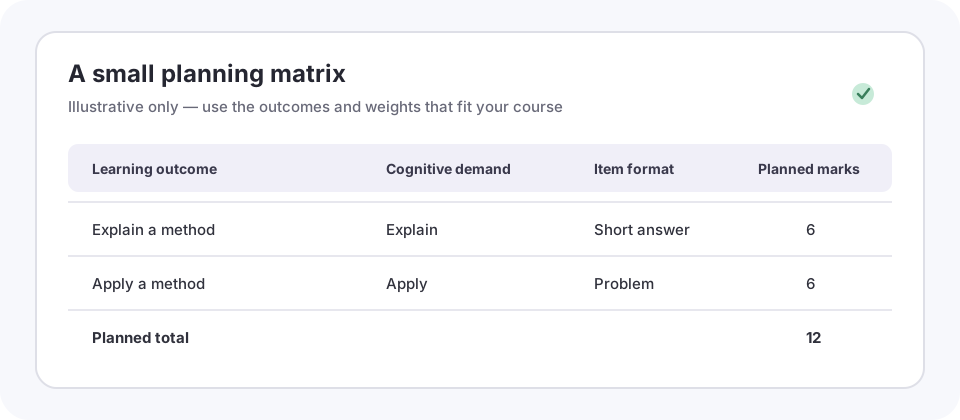
Add one row for each outcome, cognitive demand and item format you intend to include. The totals reflect only the values you enter.
- Name the intended outcome or topic.
- Choose a cognitive demand and question format that fit it.
- Enter item counts and marks to review the planned distribution.
Your plan stays in this tab. It is not uploaded or saved.
| Outcome or topic | Cognitive demand | Question format | Item count | Marks per item | Planned marks | Row actions |
|---|
One blank row is ready.
- Planned items
- 0
- Planned marks
- 0
- Rows to complete
- 0
Marks by outcome or topic
| Outcome or topic | Items | Marks | Share of planned marks |
|---|---|---|---|
| Add complete rows to see the breakdown. | |||
Marks by cognitive demand
| Cognitive demand | Items | Marks | Share of planned marks |
|---|---|---|---|
| Add complete rows to see the breakdown. | |||
Formula-like cells in the spreadsheet export are prefixed with a tab; the tab can affect later programmatic imports.
Plan the blueprint before writing individual questions
Start with the learning outcomes or course topics that the assessment is meant to address. For each planned group of items, name the cognitive demand in your own words, choose a response format, then enter item count and marks per item. The builder totals the plan and groups entered marks by outcome and by cognitive label.
Universities describe assessment planning charts as a way to decide ahead of time how many questions to ask, which subjects or learning outcomes and cognitive levels to include, and how marks are weighted. This tool records those choices; it does not prescribe a distribution or decide what a course should assess.
Use cognitive labels that fit your learning outcomes
The cognitive-demand field accepts your own text. If useful, enter labels such as remember, explain, apply, analyze, evaluate or create. Bloom’s taxonomy is one planning aid described by the University of Michigan and ANU, not a required scale for every discipline or assessment. A verb alone does not establish the thinking a question demands; inspect the task students will actually complete.
Record a question format such as multiple choice, short answer, problem, extended response, practical task or another form. Consider what evidence that task will provide for the intended outcome. A label or matrix cell cannot establish that the question is fair, clear, accessible or aligned.
Interpret totals as a planning check, not an exam score
The total planned marks are the sum of item counts multiplied by marks per item. Outcome and cognitive-demand shares use that total as the denominator. Rows with incomplete or invalid item counts or marks stay out of the arithmetic and appear in the incomplete-row count; finish or remove them before relying on the totals.
Percentages describe the values you entered. They do not show that the exam is valid, reliable, balanced, appropriately difficult or a complete measure of learning. Carnegie Mellon’s assessment guidance stresses that the student work should provide evidence of the competence an intended outcome names. Review the actual prompts, criteria, timing and access arrangements with your course context.
Keep and export your plan
Entries remain in this browser tab and are not uploaded or saved by this page. Download a .csv copy or print the table to keep a working version. Formula-like values in the spreadsheet export are prefixed with a tab to reduce formula execution risk; the tab remains in the data and can affect programmatic imports.
Questions about this topic
What is an exam blueprint?
An exam blueprint, also called a test blueprint or assessment planning chart, records which outcomes or topics an assessment intends to address, along with question formats, counts and marks. Different institutions and disciplines may use different structures.
Does the builder require Bloom’s taxonomy?
No. Cognitive-demand labels are editable text. Bloom-style verbs are optional prompts; use labels and distinctions that make sense for the course and the task.
Does the blueprint show whether an exam is valid or reliable?
No. It calculates the distribution of the numbers you enter. It does not review questions, criteria, student results, fairness, reliability or validity.
Are my course details uploaded?
No. The plan stays in this browser tab until you download it. The page does not send or save your entries.
Can I use the plan as a student study schedule?
No. It is an educator-facing planning record for an assessment. For a personal revision timetable, use the exam study plan generator.
Sources and editorial notes
The supporting reading below informs our editorial guidance. Exercises and scenarios illustrate a method; they do not report a completed product test or measured learning outcome. Read our editorial policy or send a correction with a supporting source to info@ai-essay.com.