 AI Essay
On this page
Free, local GPA calculator
Calculate semester and cumulative GPA
Enter each course, its grade and credits. The result uses the scale and repeat-course rule you choose.
Your GPA estimate
How to calculate GPA from course credits
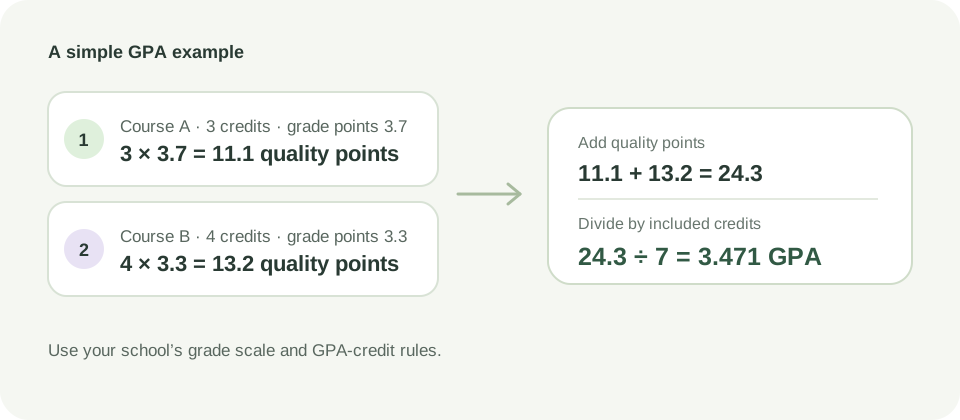
For each graded course, multiply its credit value by the grade points on the scale you selected. Add those quality points and divide by the GPA credits included in the calculation. For example, a 3-credit course at 3.7 grade points contributes 11.1 quality points. A 4-credit course at 3.3 contributes 13.2. The term GPA is 24.3 ÷ 7 = 3.471 when those are the only two included courses.
Semester or term GPA includes courses in that term. Cumulative GPA combines the quality points and GPA credits already on your record with those from the new term. If your transcript reports current GPA credits and GPA, enter both as shown. Transfer credits, pass/fail courses, incompletes and repeat grades can be treated differently by each institution; use the included-in-GPA control and confirm the calculation against your transcript and registrar.
Choose a grade scale that matches your school
A 4.0 scale with plus and minus grades is common, but it is not universal. Some institutions assign no extra points to A+, some use A+ = 4.3, and some do not use plus or minus grades. The presets in this calculator are examples, not a claim about your institution. Select Custom scale to enter the point value your registrar assigns to each letter grade.
Keep the scale consistent with the GPA already on your transcript. If you use the cumulative calculation, do not combine a 4.3-scale transcript GPA with course rows interpreted on a 4.0 scale unless you have converted them according to your institution’s rules. The tool does not convert international marks, percentages or weighted high-school honors grades.
Handle pass/fail courses and repeats explicitly
Pass/fail and transfer courses are excluded from GPA at some institutions, while other transcript marks can have different effects. Leave a course out of the calculation when it does not contribute grade points under your school’s policy. Use the same judgment for audits, incompletes, withdrawals and courses without a regular letter grade; this calculator cannot infer how your record treats them.
Repeat policies also vary. UC Berkeley generally uses the latest grade on an eligible first repeat; the University of Arizona describes undergraduate grade replacement using the highest earned grade for regular-graded courses; UW–Madison includes repeated A–F grades and grade points in its undergraduate GPA. Eligibility, credit limits and program level matter. The repeat selector here is a scenario for same-name rows in the term you entered. It cannot apply a registrar’s complete repeat policy to past coursework or change the cumulative GPA already on your transcript.
Estimate the GPA needed to reach a cumulative target
Enter your current cumulative GPA and the GPA credits behind it, then add the courses for the term being calculated. Set a target GPA and the number of GPA credits you expect to take in the future. The calculator finds the average grade points needed across those future credits after the current term is included. It is an arithmetic scenario, not a prediction or an academic standing assessment.
If the required average exceeds the maximum point value of the selected scale, the target cannot be reached in that number of credits under this simple model. A result below zero means the target has already been reached by the entered record. The calculation does not model future grade distributions, academic renewal, grade replacement across terms, minimum course grades, scholarship requirements or program-specific rules.
Supporting reading: [1]
Keep your GPA calculation in this browser
The calculator performs arithmetic in your browser. It does not send or save the course names, grades, GPA or credit values you enter. Clear the fields before leaving a shared device. This page does not connect to a student information system or retrieve an official transcript.
Questions about this topic
How do I calculate my semester GPA?
Multiply each included course’s grade points by its credits, add the quality points, and divide by the GPA credits for the term. Use your school’s grade scale and check whether pass/fail or other non-letter courses count.
How do I calculate cumulative GPA?
Multiply your current cumulative GPA by its GPA credits to estimate existing quality points. Add the quality points and credits from the term you entered, then divide total quality points by total GPA credits. Use the cumulative credits and GPA reported by your school.
Does an A+ always count as 4.3?
No. Some schools assign 4.0 to A+, some assign 4.3, and others use different scales. Choose a preset only if it matches your registrar’s grading table, or enter a custom scale.
How should I enter a repeated course?
Check your school’s rule for your program and course. The repeat selector compares same-name rows entered for this term only. It does not revise earlier transcript grades or fully reproduce eligibility limits, repeatable-course rules or academic renewal.
Are pass/fail courses included in GPA?
That depends on the institution and the specific mark. Some registrar policies exclude pass/fail courses from GPA. Use the course control to include a row only when it contributes to the GPA you are calculating.
How many credits should I enter for cumulative GPA?
Use the GPA credits or attempted graded units shown on your current transcript, not necessarily all credits earned toward graduation. Schools may report earned, attempted and GPA credits separately.
Is this an official GPA?
No. It is an estimate from the values you enter. It does not read your transcript or apply every school, program, course-repeat, rounding or academic-standing rule. Confirm your result with your registrar or advisor.
Are my grades saved or uploaded?
No. The calculation runs in this browser and does not save or send the course details you enter.
Sources and editorial notes
The supporting reading below informs our editorial guidance. Exercises and scenarios illustrate a method; they do not report a completed product test or measured learning outcome. Read our editorial policy or send a correction with a supporting source to info@ai-essay.com.
- University of Arizona Office of the Registrar: GPA calculation, term and cumulative GPA, GPA credits and excluded courses
- University of Arizona Office of the Registrar: repeated-course GPA policy by student level and course type
- UC Berkeley Office of the Registrar: grades, GPA scale, pass/no pass and repeated-course rules
- University of Wisconsin–Madison Office of the Registrar: student grades, GPA and repeated courses
- University of Wisconsin–Madison Office of the Registrar: valid grades and grade points