
Download the templates
Free blank and worked CSV records, plus a TXT worksheet with the complete fictional passage, returned answers, feedback, preparation notes and explanations. Edit the files in your own spreadsheet or notes; they do not preserve a designed page layout. No account required.
- Blank post-exam reflection and action logCSV · 491 bytes
- Three constructed item checks and planned actionsCSV · 4 KB
- Complete exam-wrapper exercise and blank promptsTXT · 7 KB
Use a blank record for your own work. Keep examples separate from your evidence and follow the instructions below.
On this page
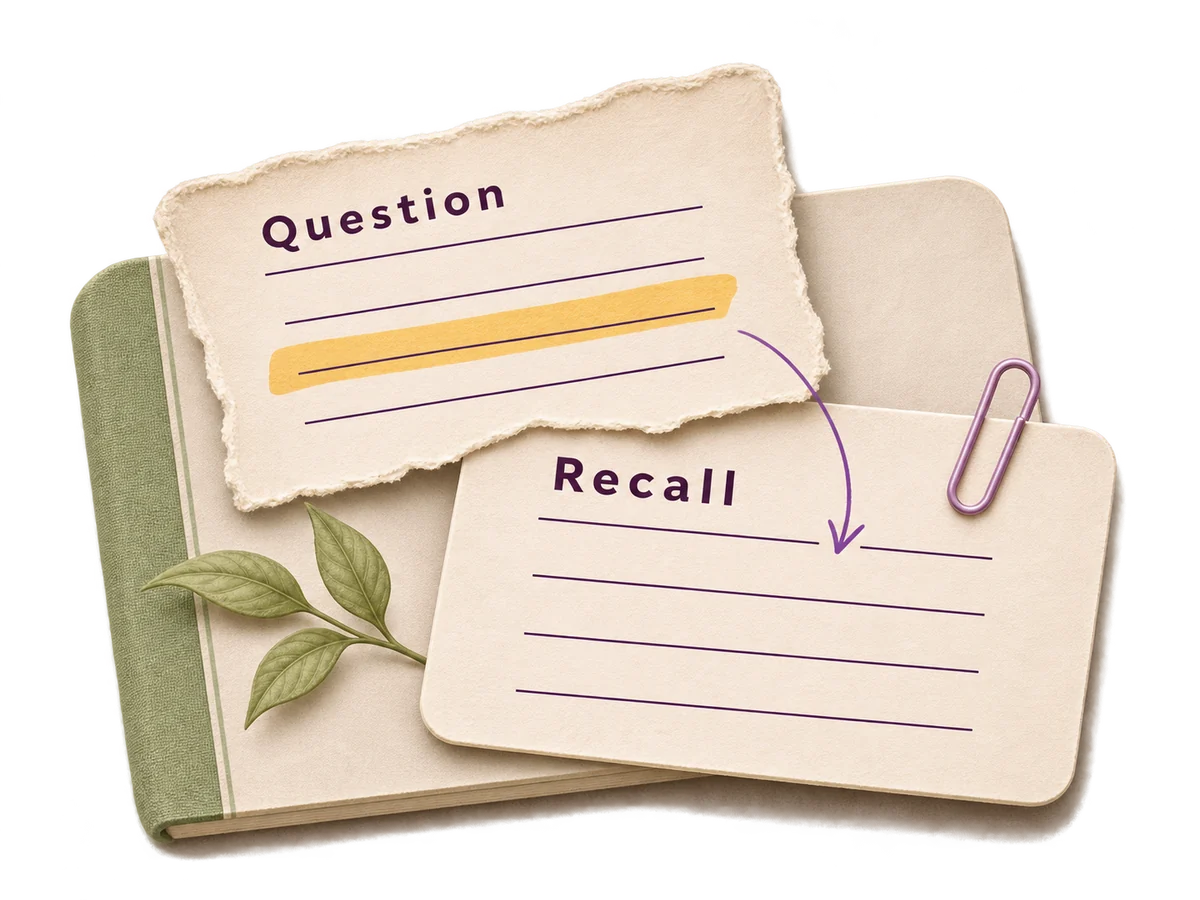
What an exam wrapper helps you inspect
An exam reflection worksheet, often called an exam wrapper, connects a returned assessment with the preparation that preceded it and the next study decision. CMU describes reviewing strengths, weaknesses, preparation and error patterns. UVM likewise recommends inspecting particular exam parts and the resources and methods used to prepare.
Start with work you are permitted to review: the returned answers, available instructor comments and an approved reference or solution. Record an item or page locator so the reflection can be checked. If the exam cannot be retained, follow the permitted review process and ask what notes may be kept. Do not copy restricted questions into a shared worksheet or upload them to a service.
Separate three statements: what the returned answer shows, what you remember doing to prepare and what might explain the outcome. The first two may inform the third, but they do not automatically establish a cause. Use the blank record to preserve that difference rather than label every error as insufficient study.
Record what you actually did before the exam
List the resources, topics and actions you used: for example, rereading notes, explaining a concept, checking a worked solution or solving a fresh problem. Record time only to the accuracy supported by your notes or recollection. A rough estimate should stay an estimate; a missing duration should stay unknown.
Also look for a strength worth preserving. A correct choice of denominator can remain useful even when the final arithmetic is wrong. Conversely, recognizing a solution while reading it is different from supplying an answer independently. Record the conditions rather than convert time spent or pages reviewed into a mastery claim.
The example below contains a small fictional preparation record. It is enough to illustrate a few next actions, not to establish which study method caused each response or to reconstruct the learner’s whole preparation.
Supporting reading: [2]
Complete fictional passage, preparation and returned items
Original fictional practice material. The passage, questions, returned answers, instructor comments and preparation notes are constructed for this exercise. No real learner, exam score, AI output or improvement is reported.
P1 — Twenty people attending an optional revision workshop chose to answer a questionnaire.
P2 — Twelve said they intended to attend another workshop.
P3 — People who did not attend the first workshop were not surveyed.
P4 — No later attendance was recorded and no group without workshops was compared.
N1 — In the fictional preparation record, the learner reread class notes about survey interpretation on two evenings. No duration was recorded, so the total study time is unknown.
N2 — The learner looked through worked fraction examples with their solutions visible. The record contains no saved independent answers to those examples.
N3 — After receiving the fictional exam, the learner remembers leaving the last item unfinished but cannot tell from memory why. No timing record was kept.
The three items are the entire practice assessment. No overall grade, mark allocation or real instructor response is reported. Keep the constructed feedback beside each answer before inspecting the reflection. The arithmetic in Q2 is part of the example, not a statistic about learning outcomes.
| Item and question | Returned answer | Constructed feedback |
|---|---|---|
| Q1 — What does the questionnaire establish about later attendance? | The workshop made twelve people attend again. | Separate an intention from a recorded outcome. The passage does not establish a causal effect. |
| Q2 — What percentage of the questionnaire respondents intended to attend again? | 12 ÷ 20 × 100 = 6%. | Your denominator matches the respondents. Check the arithmetic and retain that population in the final sentence. |
| Q3 — Give two reasons the passage cannot establish that the workshop caused later attendance. | No answer was supplied. | Item unanswered. Revisit what outcome was measured and what comparison was supplied; discuss the question if its requirements remain unclear. |
Check the answer without inventing its cause
Q1 supplies a statement to compare with the passage: it changes an intention into later attendance and adds a causal effect. Q2 has an appropriate denominator but an incorrect final percentage. Q3 supplies no answer, so the reason it was left blank cannot be recovered from the item alone.
These distinctions lead to different actions. Repeating a denominator lesson would miss the visible strength in Q2. Assuming the blank in Q3 proves a knowledge gap or poor time management would add a diagnosis the record cannot support. The table keeps an observable mismatch separate from a possible explanation.
| Item and source locator | Supported check | Correction or explanation | Cause boundary |
|---|---|---|---|
| Q1 · P2 and P4 | The answer changes intended attendance into actual attendance and adds a cause. Neither is supplied by the passage. | Twelve respondents intended to attend another workshop. Later attendance was not recorded, and a causal effect was not established. | The written answer shows an overclaim; it does not establish why the learner made it. |
| Q2 · P1–P2; 12 ÷ 20 = 0.6, and 0.6 × 100 = 60 | The selected fraction is appropriate for these respondents; the displayed percentage is not. This item does not show that the learner used the wrong denominator. | Twelve of twenty respondents, or 60%, intended to attend again. This is not a percentage of all students. | The error could have several explanations. The record does not distinguish a calculation slip from a difficulty converting the fraction to a percentage. |
| Q3 · P1, P3 and P4 | The returned item supplies no explanation to assess. A blank answer does not establish a lack of knowledge or a timing problem. | Later attendance was not measured, so the passage does not supply the outcome named in the claim. It also supplies no causal comparison that could distinguish a workshop effect from other explanations. The voluntary respondent group separately limits whom the questionnaire can describe. | The reason for the blank item remains unresolved. Ask what a complete response needs rather than diagnose the cause from a blank. |
Does N1 prove that rereading caused the Q1 overclaim?
No. N1 records an activity, while Q1 shows a mismatch with P2 and P4. The record does not isolate why that response occurred. Choose a relevant next task without presenting that choice as a proven cause.
Should Q2 be labelled a wrong-denominator error?
No. Twelve divided by twenty matches the respondents in P1–P2. The displayed final percentage is wrong: 12 ÷ 20 = 0.6 and 0.6 × 100 = 60. Preserve that correct denominator choice while checking arithmetic and population wording.
What can you conclude from the blank Q3?
Only that no answer was supplied in this fictional returned item. N3 does not establish why. Clarify the expected response and attempt a comparable question; do not claim that an unperformed retry demonstrates understanding.
Choose one action with an inspectable next check
An action should address the located issue. “Study harder” does not say what to practise; “distinguish intended from recorded attendance in a new passage” does. If the expected answer remains unclear, asking the instructor is the next action before rehearsing a guessed correction.
Duke recommends returning to the reflection before the next exam and using it to make a plan. The dates and review occasions in our blank record are chosen by you. The worksheet does not calculate an optimal interval or assume that one plan suits every course.
The actions below are proposals within a constructed exercise. No later question has been attempted. A supplied correction, a completed worksheet and a scheduled session are not evidence of a later independent answer.
| Item | Next action | What to inspect afterward |
|---|---|---|
| Q1 | Practise distinguishing an intention, a measured outcome and a causal claim in a new short passage. | Answer before checking, then compare the outcome wording and causal scope with the passage. |
| Q2 | Write the intermediate decimal and final percentage for a different fraction; explain what the denominator counts. | Check both arithmetic and the named population against the permitted worked solution. |
| Q3 | Bring Q3 and the feedback to the instructor, clarify the expected explanation, then attempt a comparable question. | After clarification, write an answer without the explanation visible and check whether two distinct limits are justified. |
Return to the record after the next attempt
Keep the first answer visible in the record rather than overwrite it with the correction. After an actual later attempt, add the date, the answer produced under the recorded conditions and the result of the source check. If the question changed, note that too; two different tasks are not automatically comparable.
For a single concept, continue with the active recall worksheet. For a returned essay, compare the instructor’s criterion with a located draft passage using the assignment self-check. Choose a study tool only after naming the task it needs to support. An automatically generated quiz or fluent explanation still needs a suitable reference check.
Bring an unresolved item and a specific question to the instructor or appropriate course support. The record can organize that conversation; it cannot determine a grade, grant reassessment rights or diagnose the reason for a difficult assessment.
Questions about this topic
What is the difference between an exam wrapper and an answer correction?
A correction addresses an answer. An exam wrapper also records actual preparation, patterns across returned items, unresolved explanations and a next study action. Neither a correction nor a filled form proves later understanding.
What if I cannot tell why I made a mistake?
Record the visible mismatch and keep the cause unresolved. Use the feedback to choose a relevant next task, or ask the instructor to clarify the expected reasoning. Do not turn a blank answer or one arithmetic error into a diagnosis.
Should I include my exam grade?
You may record it privately if useful and permitted, but item-level evidence is more actionable than the total alone. This worksheet does not calculate a predicted grade or promise a score increase.
Are the worked answers from a real student?
No. The passage, returned answers, feedback and preparation record are original fictional teaching material. Later-attempt fields stay blank because no later performance has been observed.
Can I download the worksheet without an account?
Yes. The blank CSV, worked CSV and complete TXT exercise are available without an account. Use only assessment content you are allowed to retain or share and follow the course rules for any AI assistance.
Sources and editorial notes
The supporting reading below informs our editorial guidance. Exercises and scenarios illustrate a method; they do not report a completed product test or measured learning outcome. Read our editorial policy or send a correction with a supporting source to info@ai-essay.com.