 AI Essay

On this page
Free course-planning tool
Build a learning outcome alignment map
Keep the student action, practice, submitted evidence and success criteria together. The local checks flag incomplete drafts; your course knowledge determines whether the parts truly align.
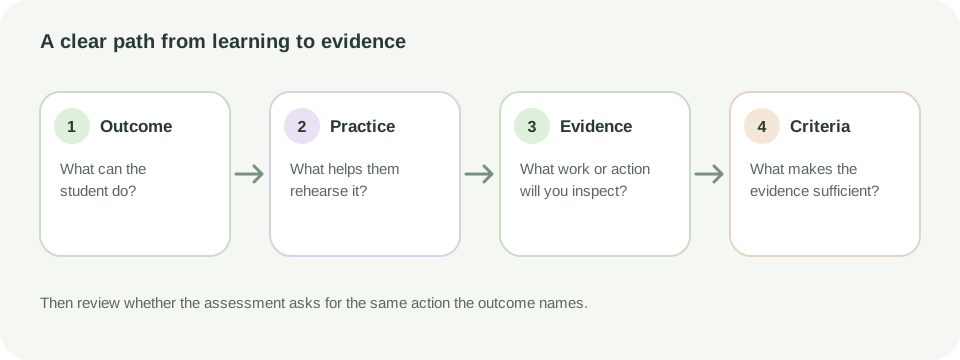
- Name the student action and course concept.
- Choose practice that prepares students for the action.
- Describe the evidence and criteria you will review.
Entries stay in this browser tab. Do not include student names, grades or identifying details.
One blank outcome is ready.
Your course alignment map
Draft completeness and word prompts are mechanical checks. Review the actual course task and use your judgment before relying on this map.
Connect the outcome, practice and evidence
A useful learning outcome names what a student should be able to do and what knowledge or skill they will use. Then choose a learning activity that gives students a chance to practise that action, and an assessment that lets them demonstrate it. For example, if an outcome asks students to compare two explanations using a graph, practice might involve annotating its labels and trends; the assessment should ask for a comparison that points to graph evidence.
The builder keeps four parts together: a learning outcome, a practice activity, the work or performance students will submit, and success criteria. Those criteria clarify what a satisfactory response needs to show. Save one row per outcome so the intended action does not disappear inside a broad course goal.
Write outcomes with observable action words
Cornell’s teaching guidance recommends action verbs that lead to behavior or products that can be observed and measured. It cautions that words such as “know,” “learn” and “understand” can be difficult to observe directly. Consider a more specific action, such as explain, compare, classify, calculate, design or justify, when that describes the learning you intend.
No verb list covers every discipline or makes an outcome measurable by itself. The builder recognizes a short set of common verbs as a writing prompt. If it finds none, read the sentence yourself and decide whether a student could show the named learning in work you can inspect. A term like “understand” may belong in a course conversation, but pair it with the response that would provide evidence of that understanding.
Review whether the assessment matches the outcome
Ask whether the assessment requires the same action stated in the outcome. If students should evaluate evidence, a recall-only quiz may not provide enough direct evidence. If students should define a term, a long research paper may add unnecessary work unless the course also intends to assess research and writing. Check the prompt, response format, criteria and feedback together.
Cornell’s guidance also recommends checking whether assessment is feasible in time and resources. A promising mapping may need revision if students cannot practise first, instructions are ambiguous, criteria are not visible, or grading effort is not manageable. This planner records your review; it cannot decide whether the assessment is valid, fair, accessible or feasible in your actual course.
Choose the right planning tool for the next step
Use this builder to connect one learning outcome to practice, evidence and criteria. The exam blueprint builder is for planning question formats, counts and marks across an exam. The analytic rubric builder is for drafting criteria and performance descriptions for a particular task. A lesson-material review checklist helps inspect a lesson plan, worksheet or quiz against its intended objective before classroom use.
The sample in the tool is constructed to show how fields relate. It is not an observed course, a validated assessment or evidence of student learning. Adapt the plan to your course, students, discipline, accessibility requirements and institutional policies.
Keep or export your course-planning notes
The tool runs in your browser tab and does not upload or save the entries on this site. Do not enter student names, grades or other identifying details. Download a CSV copy or print the map before closing or reloading the page; the tool does not provide automatic saving.
Questions about this topic
What is learning outcome alignment?
It is the process of connecting what students are expected to learn with the activities that help them practise and assessments that provide evidence of that learning. Success criteria make the expected evidence more explicit.
How do I write a measurable learning outcome?
Name a student action that can be observed in a response, performance or product, then specify the concept, context or conditions that matter. A verb alone does not prove that an outcome is clear or measurable; review it against the actual task and course.
Does the builder score my course or assessment?
No. It identifies blank fields and offers a short verb prompt. You decide whether the activity prepares students, the assessment asks for the intended action, and the criteria describe suitable evidence.
How is this different from an exam blueprint?
This builder connects an outcome to practice, student evidence and success criteria. An exam blueprint organizes planned exam outcomes, item formats, counts and marks.
Are my course details uploaded or saved?
No. The entries stay in this browser tab and are not sent to this site. Export or print the map before leaving if you need to keep it.
Sources and editorial notes
The supporting reading below informs our editorial guidance. Exercises and scenarios illustrate a method; they do not report a completed product test or measured learning outcome. Read our editorial policy or send a correction with a supporting source to info@ai-essay.com.