 AI Essay

On this page
Free, local PICO question tool
Draft a PICO question and search concepts
Use this structured worksheet for an intervention or exposure question. The first line of each field supplies the question wording; additional lines are alternatives for a search draft.
Your entries stay in this browser tab. They are not uploaded or saved. If you choose the search handoff, selected terms are held temporarily in this tab’s session storage and removed when the search builder reads them.
Review the question draft
Check each term. The search builder treats different lines as alternatives (OR) and populated groups as required together (AND). Comparison is not included. Outcome terms are optional.
View the PICO question parts
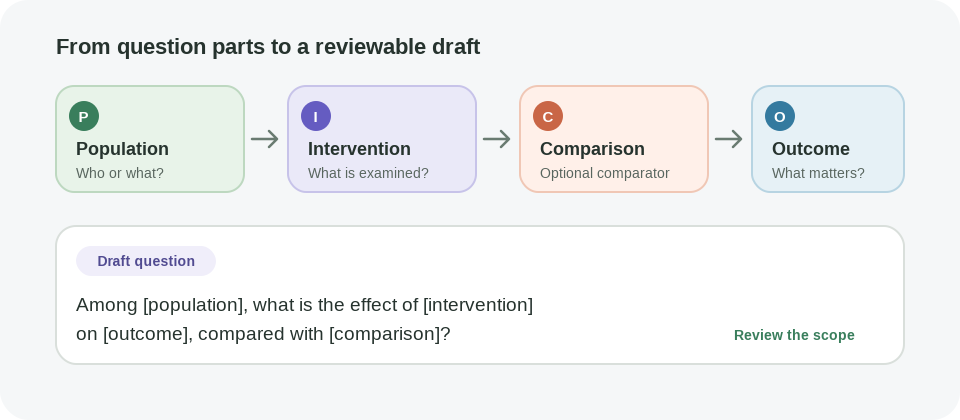
Use PICO for the question it fits
PICO stands for Population, Intervention, Comparison and Outcome. Cochrane describes it as a usual framework for questions about intervention effects, and the University of Michigan Health Sciences Library describes it as especially common for therapy or intervention-effectiveness questions. It helps make a focused question explicit; it does not decide which evidence or method is appropriate.
PICO is not a universal template. Cochrane cautions that it is generally unsuitable for questions about diagnostic test accuracy, prognosis, qualitative data or methods. The University of Michigan lists other frameworks, including PCC, PEO and SPIDER, for different question types. If your assignment is not about an intervention or exposure and outcome, use the broader <a href="/guides/research-question-worksheet">research question worksheet</a> or ask a librarian or instructor which framework fits.
Build a question from the four elements
Name the population or problem, the intervention or exposure, an optional comparison and the outcome you want to examine. Keep each element specific enough to guide the project, but do not add a population restriction, comparator or outcome only because a form has a box for it. The generated sentence is a draft for review, not proof that the question is answerable or that an intervention works.
A time boundary can clarify the question when it matters. PICOT is used in some settings, but the added letter and its definition vary; enter the time wording you actually need rather than treating it as a required part of every question.
Turn selected concepts into a search draft
The handoff places population and intervention terms into separate concept groups in the site’s <a href="/guides/search-strategy-builder">search strategy builder</a>. You choose whether to add outcome terms as a third group. The builder joins alternatives in each group with OR and populated groups with AND, so requiring an outcome group can narrow a search. Cochrane notes that outcomes may not be described in article titles or abstracts or indexed with controlled vocabulary; for a review search, consider whether requiring that group could miss relevant records.
Comparison terms are not included in the handoff by default. Decide which concepts belong in a search for your topic, confirm database syntax and controlled vocabulary, then record the actual database, dates, fields, filters and results. The handoff only prepares editable terms; it does not run a search or establish that the search is comprehensive.
Review the scope before using the question
Check that the question matches the assignment, that the population and outcome are meaningful, and that the comparison is a real decision in the project. For a systematic review, the question, eligibility rules and planned outcomes need to be specified and justified in the protocol; a generated PICO sentence is only a starting record.
This tool runs in your browser tab. It does not upload or save the entries. Its handoff uses temporary session storage in the same tab and removes the packet after the search page reads it. The output is not medical advice, a clinical recommendation, a completed protocol or evidence that a treatment is effective.
Questions about this topic
What does PICO stand for?
Population, Intervention, Comparison and Outcome. It is commonly used to frame some focused health and evidence-based practice questions, especially questions about intervention effects.
Is PICO suitable for every research question?
No. Cochrane says PICO is generally not suitable for questions about diagnostic test accuracy, prognosis, qualitative data or methods. Consider another question framework or ask a librarian or instructor.
Does the PICO builder search PubMed or another database?
No. It drafts a question and can pass selected terms to the site’s search strategy builder. You still choose the database, check its syntax and run and document the actual search yourself.
Should I include outcome terms in a systematic review search?
Review the topic and database before deciding. Cochrane notes that outcomes can be absent from titles and abstracts or poorly indexed, so requiring an outcome concept may miss relevant records.
Is PICOT the same in every course?
No. Time is commonly added in some PICOT versions, but the added element and local requirements can vary. Follow the framework assigned by your course or protocol.
Are my entries uploaded?
No. The question is built in your browser tab. If you choose the handoff, the terms are held temporarily in session storage in that tab and cleared when the search builder reads them.
Sources and editorial notes
The supporting reading below informs our editorial guidance. Exercises and scenarios illustrate a method; they do not report a completed product test or measured learning outcome. Read our editorial policy or send a correction with a supporting source to info@ai-essay.com.
- Cochrane Handbook, Chapter 1: Starting a review
- Cochrane Handbook, Chapter 4: Searching for and selecting studies
- University of Michigan Library: Asking a foreground question
- University of Michigan Library: Creating a search strategy from a foreground question
- University of Sydney Library: PICO and PICo frameworks