


On this page
What Consensus does
Consensus is an academic search product that combines paper discovery with AI-assisted summaries and deeper research workflows. Its documentation describes paper search, Pro messages, Deep reviews and filters for study characteristics. This makes it relevant to finding evidence before an essay is drafted. It is not a guarantee that the returned studies settle the question or represent every important publication.
Where it fits, and where it falls short
Useful strengths
- A research question can lead directly to papers rather than an unsupported prose answer.
- Study-design and population filters help make a large topic more specific.
- Paper search and synthesis modes support different levels of exploration.
Limits to consider
- A result set and its agreement display depend on the query and the papers retrieved.
- Study labels are AI-assisted classifications that should be checked against the paper.
- Published help pages can differ on allowances, so verify limits in the current account.
A suggested Consensus workflow

- 1
Write an answerable question and specify the population, outcome and study types you need.
- 2
Begin with paper discovery, then use relevant filters without excluding evidence simply because it is inconvenient.
- 3
Inspect methods and limitations in the most relevant original papers and compare conflicting findings.
- 4
Save source-linked notes and write a conclusion whose certainty matches the evidence you reviewed.
Paper search, Pro and Deep answer different needs
Start with the amount of interpretation you need. Paper search is appropriate when you want to browse candidate sources yourself. Pro and Deep add synthesis across retrieved papers, with Deep positioned for more involved exploration. More generated analysis does not automatically create a stronger conclusion: the question and the underlying studies still determine what can reasonably be said.
Consensus's Research Agent documentation describes follow-up searches, paper and author lookup, study comparisons and citation tracing. A useful sequence is to discover terms, inspect candidate papers and only then ask for a synthesis of a defined question. Keep track of when a follow-up changes the population or outcome so the conversation does not silently drift away from the assignment.
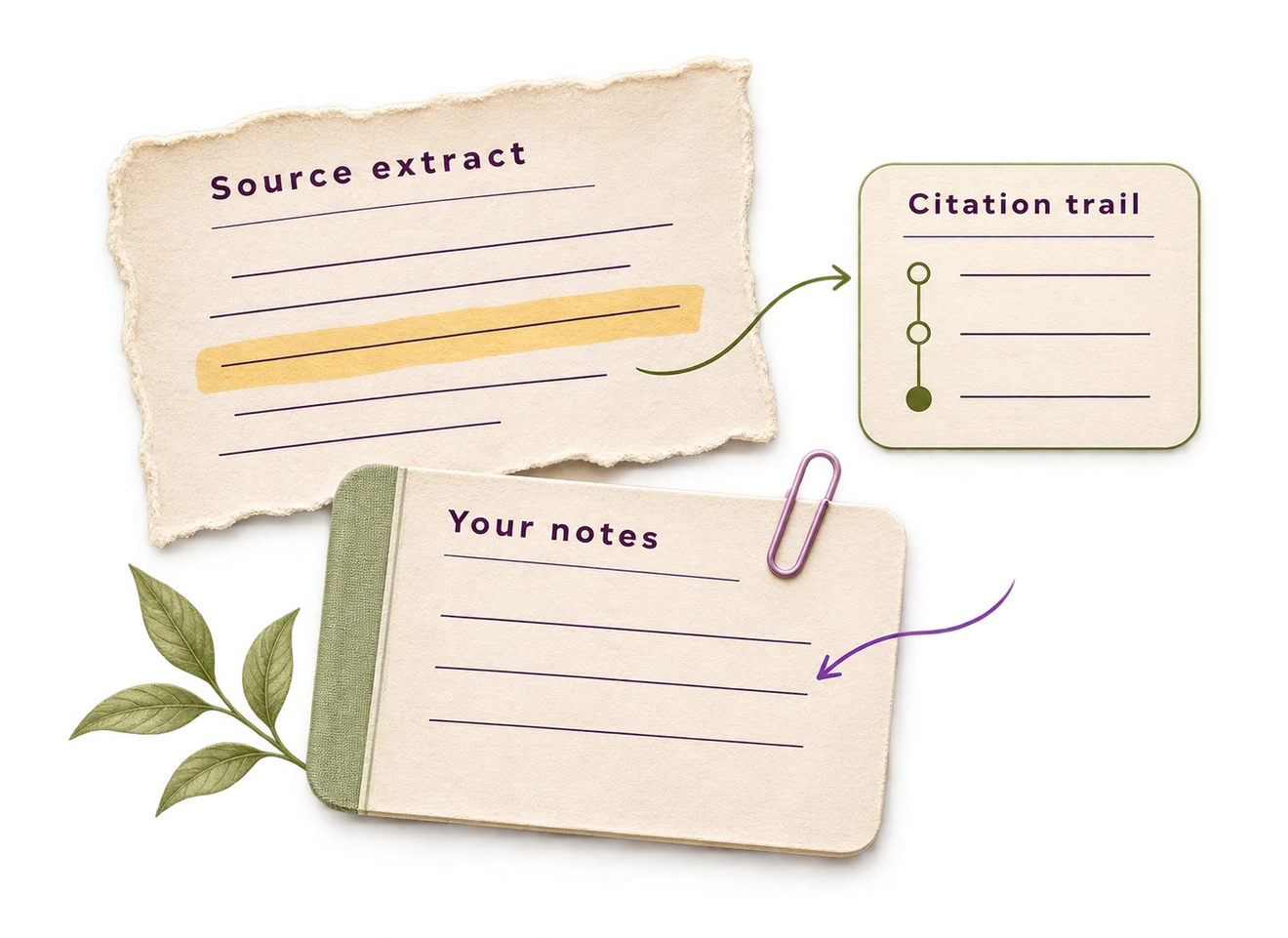
Inspect the supporting quote behind an inline citation and check whether the full-text indicator is present. Without it, the analysis used abstract and metadata. Even when Consensus analyzed a publisher’s full text, your ability to open or download the article may still depend on a personal or institutional subscription.
Use study filters to improve fit, then inspect quality
The advanced-filter documentation describes controls for publication date, access, study design, population and other paper characteristics. Choose filters that follow from your question. A study about school-age children may be poor evidence for a claim about university students, even when it appears in an influential journal. A recent date is also not a guarantee of stronger methods.
Treat filters as screening aids rather than a quality score. Open the paper to confirm the sample, comparison, measurements and limitations. If you exclude preprints or select a particular design, note that decision in your research log. A transparent scope helps readers understand what your conclusion covers and what the search may have missed.
Supporting documentation: [3]
What the Consensus Meter can and cannot tell you
The Consensus Meter is intended to summarize agreement among papers returned for an eligible question. The provider explicitly says it is not a complete representation of all research on a topic. That qualification matters: a display of agreement among retrieved results is not the same as an expert consensus established through a comprehensive review.
Use the meter as a reason to inspect the result set. Are the papers studying comparable populations? Do several results rely on overlapping data? Is the apparent disagreement explained by different outcomes or time periods? Write about the actual studies and their boundaries instead of quoting a percentage as if it settled the issue.
Supporting documentation: [4]
A worked scenario: investigate retrieval practice in studying
Suppose an education essay asks whether practice tests improve learning for undergraduates. Begin with that population and distinguish immediate performance from later retention. Search for both supportive and conflicting findings, then make a table with intervention, comparison, outcome timing and limitations. The question is narrow enough to judge whether a result belongs in your evidence base.
If a synthesis groups very different study designs together, return to the sources and separate them. Your eventual paragraph might need one claim about delayed recall and a different qualification about the classroom setting. This is an example of a research workflow to reproduce; AI Essay has not measured Consensus's answer accuracy on this task.
Choose by research task and check the plan details
Compare Consensus with SciSpace when you need a broader document-analysis workspace, with Elicit for structured extraction tasks, and with citation-network tools when you want to follow relationships between papers. A drafting assistant solves a later problem: expressing an argument after you have decided which evidence belongs in it. Avoid choosing solely because a tool generates the longest answer.
Before uploading papers or connecting a reference manager, check permissions for the materials and review the current account controls. Consensus documents library-based searching and account settings, including subscription usage. Use those controls to confirm what the live account permits. We omit headline database-size and free-credit claims here because official pages did not agree consistently during this check.
Consensus also supports uploaded documents, library-scoped questions and study-comparison tables. When comparing it with Elicit, examine how each tool supports your specific screening, extraction and source-checking steps rather than assuming that only one can organize findings into a table.
Pricing, free access and plan checks
Consensus lists a Free tier plus Pro, Deep and organizational plans. The subscription help page reviewed here lists Pro at $20 monthly or $144 annually, and Deep at $65 monthly or $540 annually. Annual totals are not monthly charges. Exact free and advanced-use allowances differ across help articles, so check the account's current Subscription page before relying on a quota.
Confirm billing period, renewal terms, limits and regional availability on the provider’s current plan page before paying.
Questions about Consensus
Is Consensus AI free?
Consensus offers a Free tier with paid plans for additional research capacity. Check the live account for current allowances; published help articles do not consistently state the same free quotas.
Does the Consensus Meter prove scientific consensus?
No. The provider explains that the meter summarizes a query's returned papers and is not a complete view of all research. Read the underlying studies and assess their relevance and quality.
Can I use Consensus sources in an essay?
You can evaluate papers discovered through Consensus and cite the original publications when they support your argument. Verify each source and follow your institution's rules for disclosing AI assistance.
Sources and research notes
This guide synthesizes official product information with our editorial assessment of academic use. Suggested exercises are examples you can repeat; they are not results of tests we performed. We do not infer accuracy from a provider’s marketing claims.
- Consensus search modes and search practices
- Consensus Research Agent documentation
- Consensus advanced search filters
- Consensus Meter and its limitations
- Consensus subscription plans
- Consensus account and usage settings
- Research database
- AI analysis and citation grounding
- Full-text and collection chat
Found a changed feature or a factual error? Send the exact page and an official source to info@ai-essay.com. Read our editorial policy for how we handle corrections.