


On this page
What RemNote does
RemNote combines notes, a document reader and flashcards, with AI assistance for creating study material. Its distinctive workflow connects source passages and your notes with cards that can enter scheduled practice. The product also documents guided PDF learning and question generation. This source-based profile explains those controls and proposes an evaluation exercise; it does not report a product test, compare memory outcomes or claim that generated cards are a complete course plan.
Where it fits, and where it falls short
Useful strengths
- Reader highlights can retain links back to a specific PDF location.
- AI-generated cards can be previewed, selected and edited before regular practice.
- Separate new-card and due-card workflows help distinguish introducing material from reviewing it.
Limits to consider
- A source-linked card can still misstate a finding or omit a qualification.
- Generating a large collection can create more review work than the topic warrants.
- PDF annotation and AI usage have separate plan and allowance constraints.
A suggested RemNote workflow

- 1
Choose a permitted reading and define the concepts you need to explain.
- 2
In the Reader, link a highlight into your notes, then draft or generate a small card set.
- 3
Check each question and answer against the passage before learning new cards.
- 4
Use scheduled reviews and a fresh application question to inspect what remains unclear.
Keep the reading passage close to the question
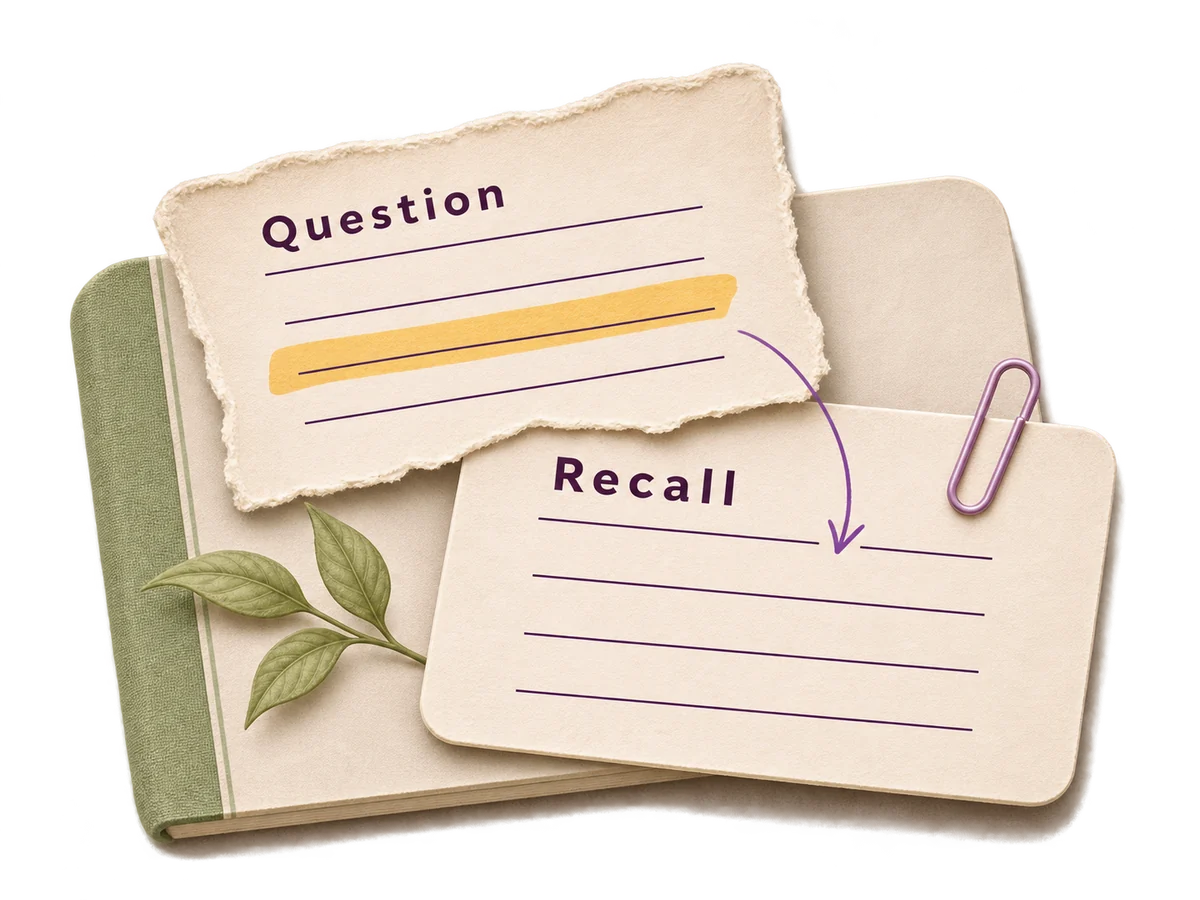
The RemNote Reader places a PDF beside a Notes pane for annotations and flashcards. Pasted highlight references can take you back to their PDF location; plain-text copying is a different option. Choose deliberately when building a reading note, so a later answer check does not depend on remembering where a sentence came from.
A link preserves location, not correctness. Compare the card with the surrounding passage and retain qualifications when simplifying a definition. Distinguish the study’s own finding from earlier work discussed in its introduction.
Supporting documentation: [1]
Generate a small candidate set and inspect it
The AI card guide describes selecting text, choosing flashcards or a multiple-choice quiz, controlling the section range and seeing estimated card counts and credit costs. A preview lets you exclude unwanted cards before saving; saved cards remain editable. Treat the generation settings as choices about scope, rather than evidence that every important concept has been selected.
Remove ambiguous prompts, questions that reveal their own answers and answers combining unrelated facts. Check that a card about a study’s measurement does not become a claim that the study proved a general rule.
Supporting documentation: [2]
Introducing cards and reviewing due cards are different actions
RemNote's documentation puts newly AI-generated cards in Need to Learn rather than immediately adding them to due reviews. Its practice guide distinguishes scheduled due-card practice from reviewing all cards. In-order practice is a Pro option and should not be mistaken for the scheduler choosing which card is due next.
If a card seems missing, inspect its learning state and document filter before generating another copy. Previewing without recording answer choices also differs from recording your own practice; the former does not alter spaced-repetition history.
A hypothetical exercise: learn a study-design distinction
Choose a public course reading that distinguishes random sampling from random assignment. This is a proposed exercise, not a RemNote session we performed. Write your own explanation of the two terms, identify the supporting passage and create a small set containing definitions plus contrasting study scenarios. Generate candidate cards only if the assignment permits it.
Check whether a proposed answer confuses selecting a representative sample with allocating participants to conditions. Edit the prompt so that it asks one clear question. Before introducing the set, add one scenario that requires explaining what the design can and cannot establish, rather than simply naming the term.
Return for scheduled reviews, then explain a new scenario without the notes. Separate a mistaken definition from a mistaken application and revise accordingly. This exercise may expose a personal workflow problem; it cannot establish product-wide accuracy or predict an exam result.
Separate note access, PDF access and AI credits
Free access includes unlimited notes and flashcards, while the Reader is a Pro feature with a three-PDF trial on Free. Pro and Pro with AI differ in AI capacity. The credits guide says Free usage resets at the beginning of each month; paid-plan usage resets monthly on the renewal day. A credit allowance is not an equivalent number of complete documents or reliable cards.
Inspect the generation estimate and account balance before repeating a large request: longer inputs and outputs affect credit use. The Pro FAQ describes limited-use feature trials, so opening a feature once does not establish permanent entitlement.
Check the input and choose the workflow you need
RemNote's AI credits guide says AI features send some note content to external providers and offers a setting to disable AI features. This does not establish that every uploaded file or school account has an identical privacy arrangement. Start with public material, check your institution's permission rules and inspect current provider terms before processing identifiable or restricted work.
Compare Quizlet for practice around a checked set, NotebookLM for explanations across selected sources and Scholarcy for structured reading notes. Those products also support study materials; flashcards are not exclusive to RemNote. Choose RemNote when connecting notes, source passages and scheduled cards is the specific missing step.
Supporting documentation: [5]
Pricing, free access and plan checks
The pricing page lists Free with unlimited notes and flashcards with a limited PDF-annotation trial. The displayed annual options are Pro at $8 per month, billed $96 yearly, and Pro with AI at $18 per month, billed $216 yearly. These are annual monthly equivalents. Monthly subscriptions also exist. Confirm checkout, the applicable AI allowance and feature limits rather than treating unlimited notes as unlimited AI generation.
Confirm billing period, renewal terms, limits and regional availability on the provider’s current plan page before paying.
Questions about RemNote
Is RemNote free?
A Free plan includes unlimited notes and flashcards, with limits on PDF annotation and AI use. Unlimited notes do not mean unlimited AI generation.
Why are my newly generated cards not due for review?
The AI card guide says generated cards enter Need to Learn first. Check their learning state and the relevant practice selection before assuming generation failed.
Do free AI credits refresh?
The official credits guide says Free usage resets at the beginning of each month. Paid-plan usage resets monthly on the subscription renewal day; check the current account allowance.
Does RemNote verify the answers on AI cards?
No accuracy guarantee is established here. Compare the question and answer with the original passage, then check understanding using a new application.
Sources and research notes
This guide synthesizes official product information with our editorial assessment of academic use. Suggested exercises are examples you can repeat; they are not results of tests we performed. We do not infer accuracy from a provider’s marketing claims.
- RemNote: Reader, PDF highlights and links to source passages
- RemNote: AI card settings, preview and new-card handling
- RemNote: practice selection, due cards and practice modes
- RemNote: current Free, Pro and Pro with AI pricing
- RemNote: monthly AI credits, usage and external processing
- RemNote: limited-use trials and subscription FAQ
Found a changed feature or a factual error? Send the exact page and an official source to info@ai-essay.com. Read our editorial policy for how we handle corrections.