
Download the templates
An original blank PDF for printing, blank and example CSV review logs, and a TXT worksheet containing the full practice passage and explained records. The PDF is a fixed page, not a fillable form. The examples are constructed teaching material, not completed learner sessions.
- Blank active recall record for printingPDF · 24 KB
- Blank active recall and review logCSV · 475 bytes
- Three constructed recall checks and planned retriesCSV · 3 KB
- Text worksheet with the complete passage and examplesTXT · 6 KB
Open a blank file for your own work. Keep examples separate from your evidence and follow the instructions below.
On this page
Make an attempt before opening the answer
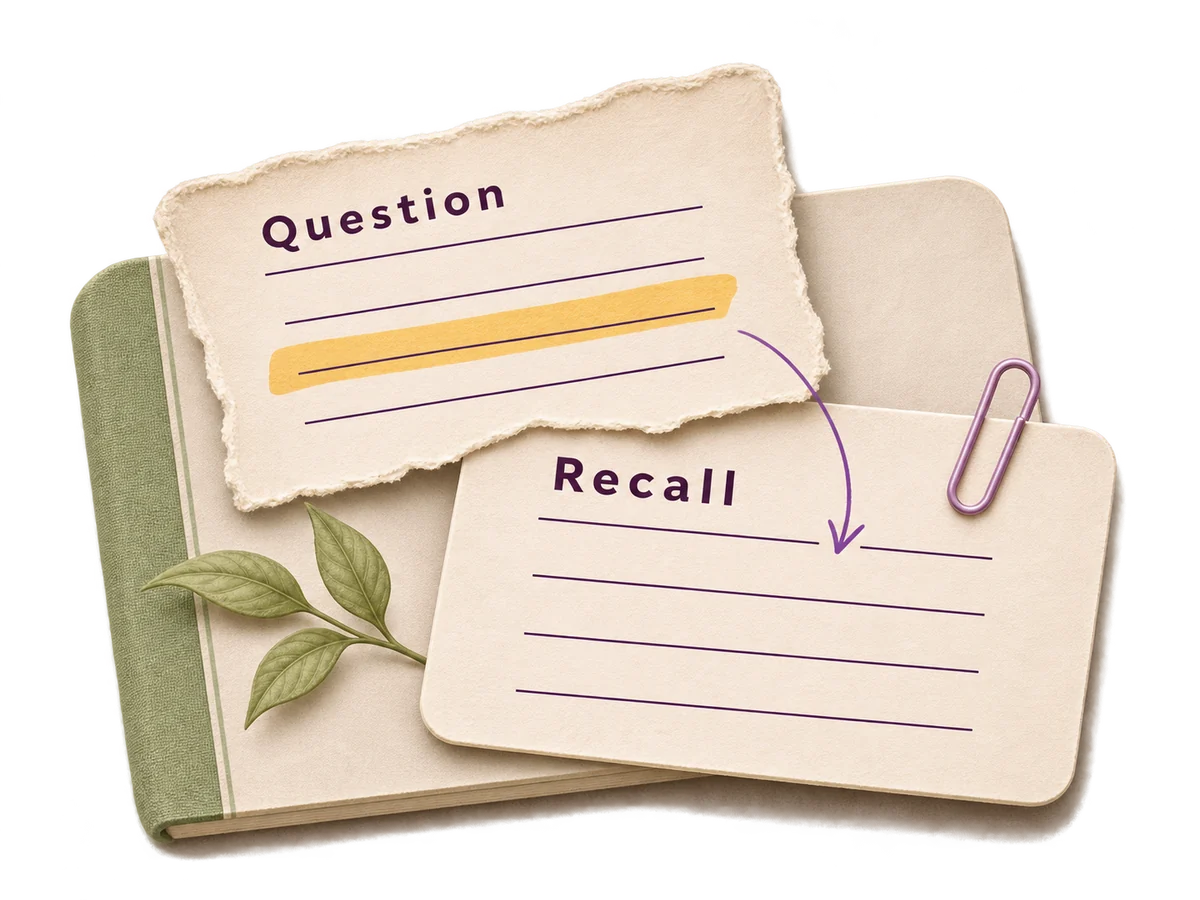
An active recall worksheet records what you can bring to mind before you inspect an answer. Start with material you have already encountered and one question about it. Put the relevant explanation out of view, write or say your answer, then compare it with an approved source. Cornell describes retrieval practice as recalling information onto a blank page, while UNC recommends creating questions and explaining ideas in your own words.
Choose a question with an inspectable answer: explain a definition in context, justify a step, distinguish two concepts or apply an idea to a new case. Copying a heading into the question field may leave the task too vague. “Explain the lecture” gives you little basis for identifying a missing qualification; “Why does this example leave the causal effect unresolved?” identifies something specific to check.
Follow the conditions of the learning task and any approved adjustments. This worksheet suggests keeping the answer out of view for the attempt, but it is not a rule that all practice must be closed book. Washington University discusses both open- and closed-book settings and frames retrieval as a learning activity rather than necessarily a graded assessment. Record the conditions you actually used instead of claiming an independent attempt after consulting the answer.
Check the attempt and record a specific correction
Keep the attempted wording. Next to it, identify the source passage, answer key or worked solution you used for the check. Record what was accurate, omitted or unsupported. A note such as “wrong” is difficult to act on; “I changed an association into a cause” identifies the reasoning that needs another attempt.
Write the correction in your own words and retain the locator that supports it. Compare meanings rather than requiring an exact match with a model answer, unless exact wording is part of the task. In a calculation, inspect the step and its justification; in an interpretation, inspect the relationship, evidence and qualification. A fluent response can still miss the condition that makes an explanation accurate.
Washington University identifies feedback as an important part of retrieval practice because it helps expose and correct errors. Your own notes may also contain an error, so return to the approved source when a point is uncertain. If the reference answer remains unclear, mark the item unresolved and ask an instructor or other appropriate course support. Do not practise an uncertain explanation repeatedly as if it were established.
Three worked records: wrong, incomplete and overextended answers
Original constructed practice records using the fictional passage from our Cornell notes example. No learner, AI session, study result or improvement across attempts is being reported. The three records illustrate separate decisions; later attempts have not been performed.
Practice lecture, entirely constructed: (1) Imagine a campus club notices that members who attend more discussion sessions also report reading more pages. (2) This describes an association in the imagined record; it does not show that attendance caused the extra reading. (3) Prior interest could influence both attending and reading, and keen readers might choose to attend more often. (4) No random assignment, time-ordered comparison or measurement procedure is supplied in this example. (5) A causal explanation would need evidence that addresses plausible alternatives, with a design appropriate to the question. (6) Do not infer that the sessions are useless: this record leaves their causal effect unresolved.
These are independent examples of how a check can change the next task. They are not three attempts by one learner and do not demonstrate improvement over time. Inspect the constructed answer, locate the relevant sentence and decide whether the proposed correction preserves the passage’s limits.
The downloadable CSV leaves actual attempt dates, chosen review dates and later answers blank. Its completed reasoning fields illustrate the record format; the TXT contains this full source passage as well as all three records. The numbered practice passage is original teaching material, not a publication to cite as research evidence.
Scroll the table sideways to view all columns.
| Practice question | Constructed attempt | Check and correction | Next retrieval task |
|---|---|---|---|
| What relationship does the passage describe, and does it establish a cause? | Attending the discussion sessions makes members read more. | Practice lecture, sentences 1–2. The passage describes attendance occurring alongside more reported reading in an imagined record. It does not establish that attendance caused the reading. Possible correction: More attendance and more reported reading occur together in this fictional record. The causal relationship remains unresolved. | With the passage hidden, describe the association without changing reported reading into a measured benefit or claiming a cause. |
| Name two possible alternatives to attendance causing more reading. | Prior interest matters. | Practice lecture, sentence 3. The attempt names one idea without explaining its role. The passage proposes that prior interest could affect both activities, and that keen readers might choose to attend more often. Possible correction: Prior interest could influence both attendance and reading. People who already read more might also choose to attend more sessions. These are possible explanations, not established causes. | Without the answer in view, explain both alternatives and state why naming a possible explanation does not prove it. |
| Does the lack of a causal conclusion show that the sessions are useless? | Yes. If the record does not prove a benefit, there is no effect. | Practice lecture, sentences 4–6. The record supplies no procedure that resolves the causal alternatives. Sentence 6 explicitly leaves the effect unresolved rather than establishing no effect. Possible correction: No. This example establishes neither a benefit nor the absence of an effect. A causal conclusion would need suitable evidence addressing plausible alternatives. | Try a differently worded question: what remains unknown after reading this record, and what would stronger evidence need to address? |
Plan a later retry without treating the date as an optimal interval
Give the next review a task as well as a date. “Review chapter 3” does not identify the difficulty; “explain why the comparison does not establish cause, with the answer hidden” does. When you return, make the new attempt before rereading the previous correction, then check it. Copying the corrected sentence straight into the later-answer field would hide the distinction between reviewing an explanation and retrieving it.
Cornell and UNC recommend distributing study across time, and Cornell’s scheduling guidance places study alongside other commitments and breaks. Choose review opportunities that fit your course, material and available time. This worksheet supplies no fixed one-day, three-day or seven-day rule. Its date field is your plan, not a calculation of the best interval for remembering a particular topic.
Leave the later-answer field empty until you actually attempt it. If the answer still omits a key point, identify the point and decide whether you need another example, a smaller question or clarification of the source. A correct-looking response on one occasion does not by itself establish durable understanding or readiness for every application. Keep planned work and observed attempts separate.
Change the question when the difficulty is understanding rather than wording
If you can repeat a definition but cannot use it, create a question that requires an explanation or decision. Ask which feature of a case fits the concept, what would change under a different condition or why a tempting answer fails. Retain the underlying source so that a new question does not introduce an unsupported rule.
The third practice record illustrates this distinction. Memorizing “association is not causation” would not be enough if you then concluded that no causal effect exists. A useful next question asks what remains unknown and what a suitable investigation would need to address. The correction targets an inference, not the number of times a phrase was repeated.
If AI assistance is permitted, you may ask for candidate questions around material you are authorized to provide. Check each question and answer against that material before using it. Keep generated prompts separate from your own attempts, and record assistance as required. A generated quiz, practice score or confident explanation is not independent verification of the course content.
Choose a format that preserves the attempt and its next action
Use the blank PDF for one handwritten practice record, or add rows to the CSV when you want a working review log. The TXT offers an editable worksheet and the complete constructed examples. CSV preserves table fields rather than a print layout; the printable PDF is static and does not contain interactive form fields or calculate review dates.
For your own log, keep the question, attempted answer, source check, correction and next task together. Record a real attempt date only after attempting, and a later answer only after returning to the question. You can use descriptions such as “needs a source check” or “retry the missing explanation” rather than turning each row into a mastery percentage.
A flashcard or study tool can carry a checked question into repeated practice. Preserve a source locator and inspect how the tool separates prompts, answers and review history. The study-tool directory compares product workflows; this worksheet supplies a record you can use independently of them. It does not evaluate a tool or promise a grade, retention gain or learning result.
Questions about this topic
What goes in an active recall worksheet?
Record a question, your answer before checking, the source and locator used to check it, a specific correction and the next retrieval task. Add a chosen review date, but leave later-answer fields blank until the attempt actually happens.
How is this different from Cornell notes?
Cornell notes organize cues, explanations and a summary while you build a reading record. This worksheet records an attempt, its check and a later retry task. A checked cue from the notes can become a practice question here.
Which spaced repetition intervals should I use?
This worksheet does not calculate an optimal interval or prescribe fixed gaps. Choose later practice opportunities around the course, material and time available, then use the checks to decide what needs attention next.
Do the examples show that the worksheet improves learning?
No. They are original constructed teaching records, not learner sessions or measured outcomes. The university sources inform the practice method; they did not evaluate this worksheet, its examples or an AI service.
Sources and editorial notes
The supporting reading below informs our editorial guidance. Exercises and scenarios illustrate a method; they do not report a completed product test or measured learning outcome. Read our editorial policy or send a correction with a supporting source to info@ai-essay.com.
- Cornell Learning Strategies Center: retrieval and distributed practice
- UNC Learning Center: active study questions, explanation and distributed practice
- Washington University Center for Teaching and Learning: retrieval practice, feedback and practice conditions
- Cornell Learning Strategies Center: creating a realistic study schedule