

On this page
What Undermind does
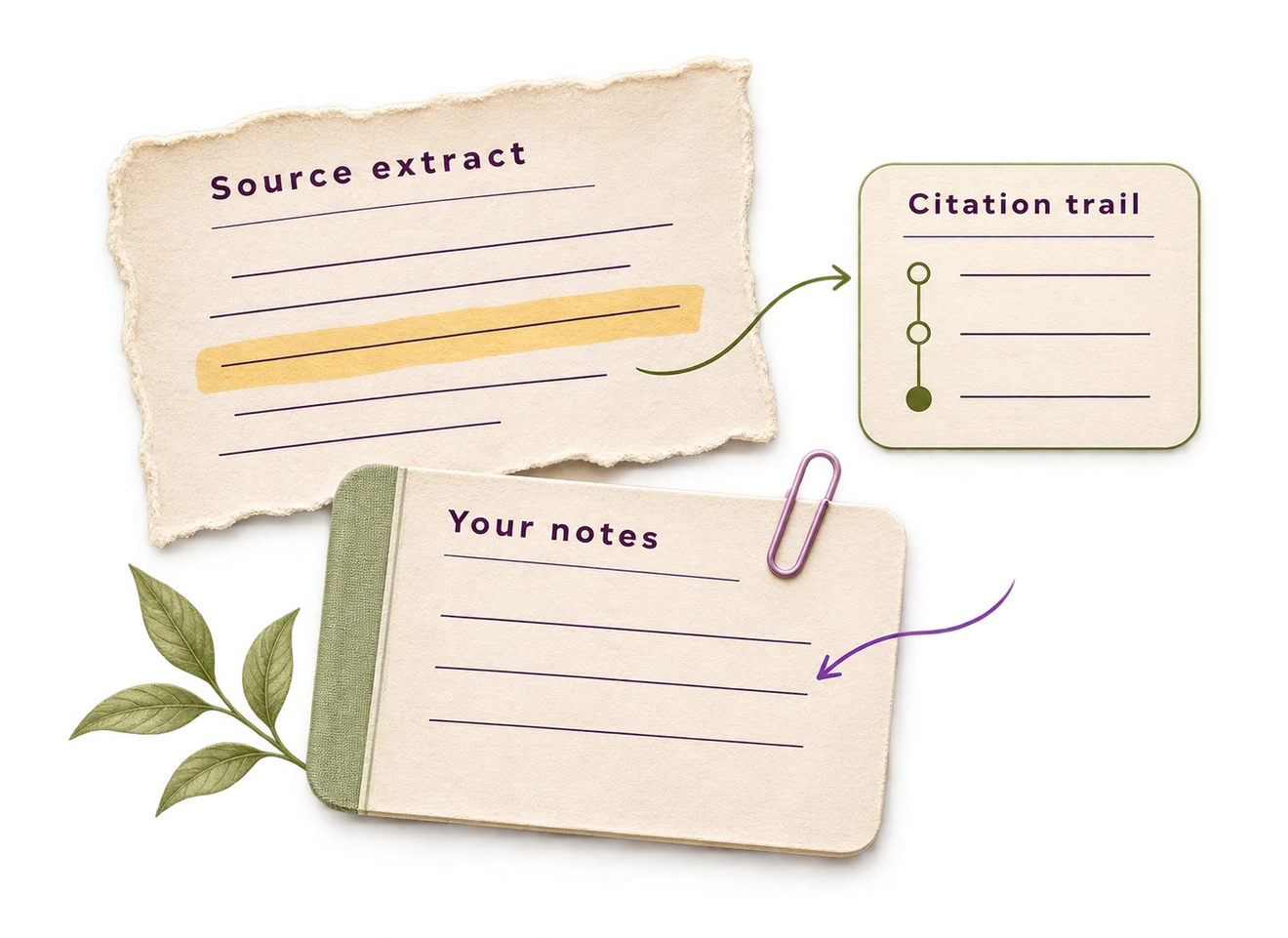
Undermind combines literature discovery with a workspace for papers, reading and research notes. Its documented search process adapts as it finds relevant work. This guide focuses on turning a specific academic question into an inspectable reading list, then separating discovery from full-text evaluation. It reports official capabilities and editorial guidance, not a completed search, accuracy test or ranking against other services.
Where it fits, and where it falls short
Useful strengths
- A detailed research goal can guide successive discovery passes rather than one fixed keyword list.
- Search, paper reading and persistent notes can support an ongoing project.
- Official documentation distinguishes available open-access PDFs from documents supplied by the user.
Limits to consider
- Search coverage and the stopping condition do not establish that every eligible study was found.
- A relevant paper can still have weak methods or fail to support your intended claim.
- Usage allowances, source access and project export need separate checks.
A suggested Undermind workflow

- 1
Write the population, setting, outcome and exclusions before starting the search.
- 2
Inspect candidates and near-misses, keeping a record of any changes to the research brief.
- 3
Obtain permitted full texts and check the methods and passages behind important findings.
- 4
Save verified references and inclusion decisions independently, then screen later additions against the same criteria.
Write a brief that can exclude a plausible result
A useful search brief says more than a subject name. Specify what must be measured, who or what is being studied, and which neighboring questions do not count. Undermind’s documented deep-search tool accepts an open-ended research goal and plans further searches from it. The quality of the question remains your responsibility.
Before starting, write one example of a paper that would qualify and one near-miss. An attendance study is different from a study reporting only student satisfaction. If you change the boundary after seeing results, record the change and decide whether earlier candidates need screening again. This prevents the question from quietly becoming whatever the tool happened to retrieve.
Supporting documentation: [2]
A search stopping is different from the literature being complete
The official research-tool documentation describes successive searches that follow citations and authors, with a stopping condition based on finding no new relevant papers. The homepage FAQ also explains that a missing paper may be absent from its source database or may not have appeared in the search’s first passes. It names Semantic Scholar as the paper-search source; that does not establish coverage of every specialist database.
Treat a completed run as a candidate set to inspect. Check for a few known relevant papers and investigate omissions by title or DOI elsewhere. Keep the exact brief and the date of each additional pass. For a formal review, agree the required databases and search records with your supervisor or librarian; an adaptive search is not a substitute for those requirements.
Check whether a conclusion came from a record or the full text
Undermind’s reading-tool documentation describes fetching open-access PDFs and reading other PDFs after workspace upload. Discovering a paper’s record is therefore separate from having its complete text available. Upload only material you are permitted to process, and check which version you are reading.
Use an abstract to screen apparent relevance, then verify the method and outcome in the paper itself. For a figure, inspect the axes, sample, units, caption and uncertainty before relying on a generated explanation. If the full text is unavailable, mark the decision as unresolved rather than filling missing details from another paper. We have not tested figure interpretation or PDF extraction in an account.
Supporting documentation: [2]
A hypothetical exercise: lecture recordings and live attendance
Suppose a literature assignment asks about lecture recordings made available before class and separately measured live attendance among undergraduates. This is an unrun evaluation exercise. Define the setting and time period, require an attendance measure, and exclude papers that report only recording views or satisfaction. Keep studies of recordings released after class in a separate group unless your question includes them.
For each candidate, record the title or DOI, recording-release timing, how attendance was measured, study design and reason for inclusion or exclusion. A paper about online participation might be a useful near-miss while failing the live-attendance criterion. Ask for the passage behind each important field, then check it in the full text. Do not invent an expected result to make the search look successful.
Compare the found set with a known relevant paper and a separately recorded database search. Investigate missing records and changes introduced by extending the search. A small exercise can reveal a workflow problem, but it cannot establish general recall, time savings or that lecture recordings caused an attendance change. Keep the search audit separate from your final interpretation of the studies.
Keep a durable research record beyond one workspace
The MCP tool list documents Markdown notes and reports saved in a workspace, plus temporary download links for available PDFs. Its integration reference says connected agents act through a particular user’s authorized workspace. These are documented integration capabilities, not a test of the website’s export controls or every plan’s entitlement.
Before moving a project, verify the actual handoff you need: bibliographic records for a reference manager, your screening notes, source PDFs and the report. We have not confirmed a current website guide for BibTeX, RIS or CSV export, or a complete workspace backup. That uncertainty does not mean those options are unavailable. Check them in the account before assuming a saved report preserves the whole project.
Keep your own DOI or title list and inclusion reasons in a format you can reopen independently. Before connecting another assistant, review which workspace it will access and what it can change. An authenticated connection does not establish that an unpublished manuscript is approved for upload under your institution’s rules.
Check access conditions and choose the next research step
Use free access to inspect the workflow before planning a large project around it. Confirm the current search limits and which account receives an academic or team entitlement. The refund policy places cancellation under Manage Subscription and distinguishes stopping renewal from a refund for a billing period that has already begun. Check the current terms before paying; this profile has not tested billing or cancellation.
Compare Elicit when the next task is structured extraction or a dedicated review workflow, and Consensus for question-led evidence discovery. ResearchRabbit and Litmaps offer seed-based routes into connected literature. These products overlap; adaptive discovery is not an exclusive capability or a reason to assume Undermind will find better evidence. Choose using a defined research task and a source-checking exercise you can repeat.
Pricing, free access and plan checks
Undermind lists Free, Pro, Team and Enterprise access. Free has rate limits; a file or workspace allowance does not establish unlimited AI searches. The pricing interface varies by academic or industry audience, billing period and team selection. Confirm the applicable total, usage limits and renewal terms in the account rather than treating an annual monthly equivalent as a monthly subscription.
Confirm billing period, renewal terms, limits and regional availability on the provider’s current plan page before paying.
Questions about Undermind
Is Undermind free?
A Free plan is listed with rate limits, alongside paid options. Confirm the current allowance, audience and billing period; we have not verified a fixed number of free searches or a universal reset schedule.
Does a completed search find every relevant paper?
No completeness guarantee is established here. The documented search adapts and stops according to its discovery process. Check known papers, investigate omissions and use the additional databases your review requires.
Can Undermind read paywalled papers?
Its reading documentation distinguishes automatically fetched open-access PDFs from PDFs uploaded to the workspace. Finding a record does not itself grant access to a publisher’s full text. Supply only documents you are permitted to use.
Can I export references to Zotero or another manager?
We have not confirmed a current official website guide for BibTeX, RIS or reference-manager synchronization. The documented integration supports Markdown files and temporary PDF download links, which are different from a full bibliography export. Verify the format you need in the account.
Did AI Essay test Undermind’s search accuracy?
No. This is a source-based profile with a hypothetical search exercise. We have not reproduced the provider’s benchmark or measured search recall, reading accuracy or time savings.
Sources and research notes
This guide synthesizes official product information with our editorial assessment of academic use. Suggested exercises are examples you can repeat; they are not results of tests we performed. We do not infer accuracy from a provider’s marketing claims.
- Undermind: current product, pricing and search FAQ
- Undermind: documented search, reading, workspace and monitoring tools
- Undermind: user-scoped workspace authorization
- Undermind: cancellation and refund conditions
Found a changed feature or a factual error? Send the exact page and an official source to info@ai-essay.com. Read our editorial policy for how we handle corrections.