 AI Essay

On this page
Local research planning tool
Plan the study before you inspect its results
Write down the question, variables, sample, outcome measures, exclusions, primary analysis and contingencies in one editable draft. Separate planned analyses from exploratory work.
Draft preview
What an empirical study plan should record
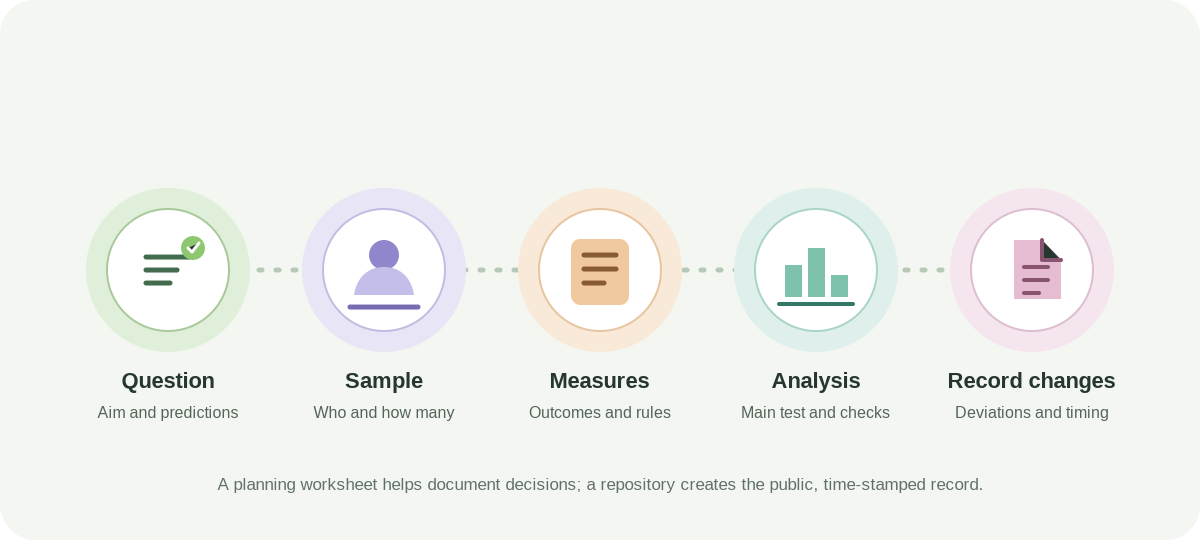
A useful plan connects the research question to the decisions that will shape the study and its analysis. Depending on the design, record the hypotheses or aims, sample and stopping rule, measures and variables, eligibility and exclusions, data preparation, primary analysis, interpretation criteria and foreseeable contingencies. The relevant decisions differ across experimental, observational and other study designs; a generic form cannot determine which methods fit a particular question.
The OSF guidance recommends explicit hypotheses and variables, making design and analysis decisions before viewing data, stating exclusions, model and covariates, planned outcomes, contingencies and possible deviations. These are prompts to discuss with your supervisor or research team, not universal requirements for every discipline or project.
Separate planned analyses from exploratory work
Identify the main outcome and analysis before looking at results, and describe secondary, sensitivity or subgroup analyses separately. If assumptions may fail, state what you will check and which alternative you would use. Explain how multiple outcomes or comparisons will be handled and whether interim looks at the data are planned. A plan should describe the decisions you intend to make, not imply that the data will follow an expected pattern.
Preregistration clarifies which decisions were made in advance and which analyses followed later observations. Nosek and colleagues emphasize that respecting both the original plan and what actually happened requires transparent reporting and judgment. An unexpected result can still be reported; label an unplanned analysis accurately rather than rewriting the earlier plan.
Use this planner as a local working draft
The planner groups questions about the study, sample, measures, case rules, analysis, contingencies and oversight. It counts fields with entries so you can find unfinished decisions. The count is not a completeness score, quality rating or compliance check. Empty sections remain visible in the Markdown export so you can see what still needs attention.
The form and exports stay in your browser. It does not submit to OSF or another registry, create a timestamped public record, calculate statistical power, select a valid method, grant ethics approval or save answers automatically. Download the JSON backup if you want to preserve your draft. Avoid entering names, participant records or other confidential information.
Submit a registration through an appropriate repository
A preregistration is more than a downloaded file: it is a time-stamped plan posted to an appropriate repository before data collection or analysis. The local planner prepares a draft for review, but the researcher or study team must choose a suitable registration template and complete that repository’s own submission and review steps.
OSF’s current guidance describes OSF Registries as the place to create a time-stamped record and notes that new registrations are made through OSF Registries or My Registrations. Templates and requirements vary; check the current official workflow, your institutional rules and any community registry before submitting. If data collection or analysis has already begun, disclose the stage and timing rather than describing a retrospective record as prospective preregistration.
Questions about this topic
Does this planner preregister or time-stamp my study?
No. It creates a local Markdown draft or JSON backup in your browser. A preregistration is posted to a suitable repository as a time-stamped record before data collection or analysis. You must review and submit it through the repository itself.
Can I use the template after I have looked at my data?
You can document a plan at a later stage, but it must disclose when the plan was written and whether data or outcomes were already examined. Do not describe a retrospective plan as prospective preregistration.
Does an empty-field count mean my plan is complete?
No. The count only identifies fields containing text. It does not rate methodological quality, determine whether a section applies, or confirm that the decisions fit your study.
Does this planner calculate sample size or choose a statistical test?
No. Record a sample-size rationale and planned analysis that you have selected with appropriate guidance. Separate tools can help you inspect specific assumptions, but they do not determine which method is suitable for your full study.
Is the draft submitted or automatically saved?
No. Entries remain in the current browser tab until you leave or clear them. Download a JSON backup to preserve your work. The tool does not upload plan contents or submit them to a repository.
Sources and editorial notes
The supporting reading below informs our editorial guidance. Exercises and scenarios illustrate a method; they do not report a completed product test or measured learning outcome. Read our editorial policy or send a correction with a supporting source to info@ai-essay.com.