 AI Essay

On this page
Local questionnaire review tool
Review survey questions with the people who will answer them
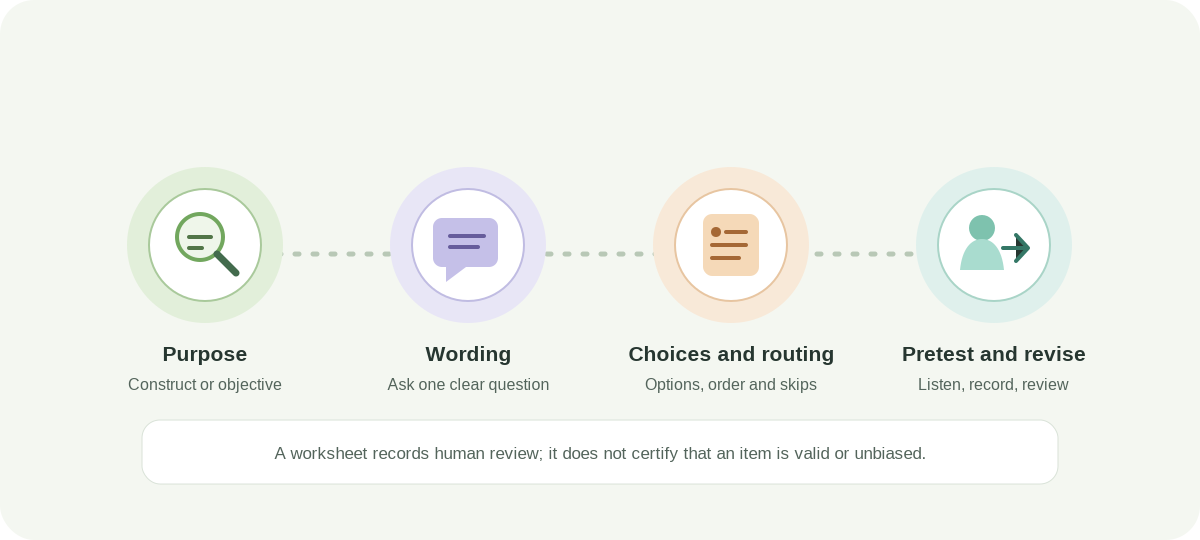
Keep each item’s purpose, exact wording, response choices, routing, reviewer findings and next revision together. Use the record to guide human pretesting; it cannot certify a question as clear, fair or valid.
Prompts for a cognitive interview
- Understanding: What does this question mean to you?
- Recall: How did you remember that?
- Judgment: How sure are you about that answer?
- Response: How did you choose that option?
Ask follow-up questions to learn how people interpret and answer an item; a checklist cannot substitute for those conversations.
Review plan preview
Why review survey questions before launch
A question can look clear to its author and still prompt respondents to interpret a term differently, use an unexpected time period, struggle to recall an event or find no suitable response option. Reviewing wording on a screen cannot reveal all of those problems. The review workspace keeps the intended construct separate from the exact question text so a team can check whether the answer is likely to address the research aim.
AAPOR recommends questions that focus on one concept, use short language suited to the intended audience and avoid wording that pushes respondents toward an answer. Closed-ended response options should be reviewed for overlap, missing reasonable choices and logical order. These are prompts for human scrutiny, not an automated pass/fail standard.
Use cognitive interview probes to understand answers
Cognitive interviewing examines how people understand and answer questions. CDC describes probes about comprehension, recall, judgment and response choice. Ask the person to explain what a term means, how they remembered the information, how certain they are and how they selected an option. The goal is to understand interpretation and locate trouble spots, not to estimate population results from a small qualitative pretest.
Recruit people whose experience resembles the intended respondents and record de-identified observations. A generic checklist cannot replace interviews or another appropriate qualitative pretest. If findings differ across respondents, note the difference rather than flattening it into a single “clear” label.
Supporting reading: [2]
Review response options and survey routing
For each item, preserve the current wording and list the response choices in their actual displayed order. Check whether choices overlap, leave common answers out, include a suitable “not sure” or “prefer not to answer” where relevant, and match the requested recall period. Note whether the item is open text, single choice, multi-select, numeric or a scale.
Describe when the question appears and where each response leads. A full pilot should test the programmed questionnaire and its procedures, including recruitment, display, skip rules, completion and data cleaning. The workspace records checks and decisions but does not execute a survey or verify the instrument’s live implementation.
Supporting reading: [1]
Document revisions without claiming validated wording
Keep the original question, de-identified finding, team action and proposed revision connected. This makes it easier to revisit why wording changed and what still needs testing. When comparing two phrasings, document which version respondents saw and what else changed; a difference in responses cannot automatically be attributed to wording if other parts of the design also changed.
Do not treat a polished draft or completed checklist as proof that a question is unbiased, reliable or valid for every context. The appropriate evidence depends on the intended construct, audience, survey mode and use of results. Obtain institutional ethics and privacy guidance before recruiting participants or handling sensitive topics.
What the local review workspace does
The workspace creates question cards with fields for construct, exact wording, recall period, answer format, response options, routing, pretest probes, de-identified findings, proposed revision and sensitive-topic safeguards. It can export a review plan as Markdown or keep an editable JSON backup for the next session.
The form does not upload or save answers automatically. It does not generate or validate question wording, store participant responses, assess sample size, grant ethics approval, certify validity or replace a cognitive interview and full pilot. Avoid entering identifiable material; keep exported files under the storage and access rules for your study.
Questions about this topic
Can this worksheet tell me whether a survey question is unbiased?
No. It can help your team document what to inspect and what people say during pretesting. It does not score, certify or establish that a question is unbiased or valid.
What is a cognitive interview?
It is a qualitative method for examining how respondents understand a survey question and arrive at an answer. Probes can ask about comprehension, recall, judgment and response choice.
Should I test questions with people like my intended respondents?
Yes. AAPOR recommends pretesting with people similar to those who will take the survey. Follow your study’s institutional guidance on recruitment, consent, ethics and privacy.
Does this tool collect participant answers?
No. It has no survey-taking function, server submission or automatic save. Record only de-identified summaries of review findings, not names, raw transcripts or sensitive responses.
Does a small pretest establish statistical validity?
No. Cognitive interviews can reveal how people interpret questions and help identify issues; they are not a population estimate or a general validity certificate. Choose further evaluation based on the construct, intended respondents and use.
Sources and editorial notes
The supporting reading below informs our editorial guidance. Exercises and scenarios illustrate a method; they do not report a completed product test or measured learning outcome. Read our editorial policy or send a correction with a supporting source to info@ai-essay.com.